How many amps a generator produces depends on its power rating and the voltage you’re using. If you’re trying to figure out whether your generator can run jobsite tools, support lighting and sound at an event or provide backup power during an outage, amperage is one of the key numbers to check. Knowing how to convert kW to amps upfront makes it easier to plan your setup and avoid tripped breakers or overloaded equipment.
This generator sizing guide includes easy-to-read amp conversion charts, conversion formulas like amps to kW and clear explanations to help you estimate output current.
Understanding Generator Power Units (kW, kVA, Amps)
When sizing a generator (sometimes called gensets, for “generator sets”), you’ll see three key power units: kW, kVA and amps. Each one measures something slightly different, and understanding how they work together helps you choose the right equipment and avoid overload issues.
Amps (Amperage)
Amps measure the flow of electrical current. Think of amperage as how much electricity is actually moving through the wires at a given moment. Every tool, appliance or piece of equipment draws a certain number of amps to operate. If your generator can’t supply enough amps, equipment may struggle to start or run properly.
kW (Kilowatts)
Kilowatts measure the usable power that actually performs work. This is the energy that runs lights, tools, HVAC systems and other equipment. When people talk about how much power they need, they’re often referring to kilowatts.
kVA (Kilovolt-Amperes)
kVA measures apparent power, which represents the total power supplied by the generator before accounting for efficiency losses. It reflects the combined effect of voltage and current in the system.
kW vs. kVA: What’s the Difference?
The difference between kilowatt and kilovolt-ampere comes down to this: kW is the usable power that runs your equipment, while kVA is the total power the generator supplies. Because of system inefficiencies, not all supplied power turns into usable energy, which is why kW is typically lower than kVA.
In simple terms:
- kVA = total power delivered
- kW = power that actually performs work
Why Power Factor Matters
Power factor shows how kW and kVA relate to each other. It’s usually written as a decimal. It tells you how the supplied power of a generator is being converted into usable energy.
For example, many generators are rated at a 0.8 power factor, meaning:
kW = kVA × 0.8
If a generator is rated at 100 kVA with a 0.8 power factor, it can deliver 80 kW of usable power.
Understanding power factor is important because it directly affects electrical load calculations and generator sizing. If you ignore it, you may overestimate how much usable power your generator can provide.
Generator Amperage Chart
The number of amps your generator produces depends on its power rating, voltage and whether it’s single-phase or three-phase. This chart provides estimated amperage output at an 80 percent power factor, which is standard for many industrial generators.
kW represents the usable power your equipment runs on, while kVA reflects total supplied power. In AC systems, these values differ because voltage and current are not always perfectly aligned. That difference affects how much usable power you actually get.
Use the table below as a reference to estimate generator amperage across common voltages.
| kVA | kW | 208 V | 220 V | 240 V | 380 V | 400 V | 440 V | 450 V | 480 V | 600 V | 2400 V | 3300 V | 4160 V |
| 8 | 6.3 | 17.5 | 16.5 | 15.2 | 9.6 | 9.1 | 8.3 | 8.1 | 7.6 | 6.1 | — | — | — |
| 9.4 | 7.5 | 26.1 | 24.7 | 22.6 | 14.3 | 13.6 | 12.3 | 12 | 11.3 | 9.1 | — | — | — |
| 12.5 | 10 | 34.7 | 33 | 30.1 | 19.2> | 18.2 | 16.6 | 16.2 | 15.1 | 12 | — | — | — |
| 18.7 | 15 | 52 | 49.5 | 45 | 28.2 | 27.3 | 24.9 | 24.4 | 22.5 | 18 | — | — | — |
| 25 | 20 | 69.5 | 66 | 60.2 | 38.4 | 36.4 | 33.2 | 30.1 | 24 | 6 | 4.4 | 3.5 | — |
| 31.3 | 25 | 87 | 82.5 | 75.5 | 48 | 45.5 | 41.5 | 40.5 | 37.8 | 30 | 7.5 | 5.5 | 4.4 |
| 37.5 | 30 | 104 | 99 | 90.3 | 57.6 | 54.6 | 49.8 | 48.7 | 45.2 | 36 | 9.1 | 6.6 | 5.2 |
| 50 | 40 | 139 | 132 | 120 | 77 | 73 | 66.5 | 65 | 60 | 48 | 12.1 | 8.8 | 7 |
| 62.5 | 50 | 173 | 165 | 152 | 96 | 91 | 83 | 81 | 76 | 61 | 15.1 | 10.9 | 8.7 |
| 75 | 60 | 208 | 198 | 181 | 115 | 109 | 99.6 | 97.5 | 91 | 72 | 18.1 | 13.1 | 8.7 |
| 93.8 | 75 | 261 | 247 | 226 | 143 | 136 | 123 | 120 | 113 | 90 | 22.6 | 16.4 | 13 |
| 100 | 80 | 278 | 264 | 240 | 154 | 146 | 133 | 130 | 120 | 96 | 21.1 | 17.6 | 13.9 |
| 125 | 100 | 347 | 330 | 301 | 192 | 182 | 166 | 162 | 150 | 120 | 30 | 21.8 | 17.5 |
| 156 | 125 | 433 | 413 | 375 | 240 | 228 | 208 | 204 | 188 | 150 | 38 | 27.3 | 22 |
| 187 | 150 | 520 | 495 | 450 | 288 | 273 | 249 | 244 | 225 | 180 | 45 | 33 | 26 |
| 219 | 175 | 608 | 577 | 527 | 335 | 318 | 289 | 283 | 264 | 211 | 53 | 38 | 31 |
| 250 | 200 | 694 | 660 | 601 | 384 | 364 | 332 | 324 | 301 | 241 | 60 | 44 | 35 |
| 312 | 250 | 866 | 825 | 751 | 480 | 455 | 415 | 405 | 376 | 300 | 75 | 55 | 43 |
| 375 | 300 | 1040 | 990 | 903 | 576 | 546 | 498 | 487 | 451 | 361 | 90 | 66 | 52 |
| 438 | 350 | 1220 | 1155 | 1053 | 672 | 637 | 581 | 568 | 527 | 422 | 105 | 77 | 61 |
| 500 | 400 | 1390 | 1320 | 1203 | 770 | 730 | 665 | 650 | 602 | 481 | 120 | 88 | 69 |
| 625 | 500 | 1735 | 1650 | 1504 | 960 | 910 | 830 | 810 | 752 | 602 | 150 | 109 | 87 |
| 750 | 600 | 2080 | 1980 | 1803 | 1150 | 1090 | 996 | 975 | 902 | 721 | 180 | 131 | 104 |
| 875 | 700 | 2430 | 2310 | 2104 | 1344 | 1274 | 1162 | 1136 | 1052 | 842 | 210 | 153 | 121 |
| 1000 | 800 | 2780 | 2640 | 2405 | 1540 | 1460 | 1330 | 1300 | 1203 | 962 | 241 | 176 | 139 |
| 1125 | 900 | 3120 | 2970 | 2709 | 1730 | 1640 | 1495 | 1460 | 1354 | 1082 | 271 | 197 | 156 |
| 1250 | 1000 | 3470 | 3300 | 3009 | 1920 | 1820 | 1660 | 1620 | 1504 | 1202 | 301 | 218 | 174 |
| 1563 | 1250 | 4350 | 4130 | 3765 | 2400 | 2280 | 2080 | 2040 | 1805 | 1503 | 376 | 273 | 218 |
| 1875 | 1500 | 5205 | 4950 | 4520 | 2800 | 2730 | 2490 | 2440 | 2260 | 1805 | 452 | 327 | 261 |
| 2188 | 1750 | — | — | 5280 | 3350 | 3180 | 2890 | 2830 | 2640 | 2106 | 528 | 380 | 304 |
| 2500 | 2000 | — | — | 6020 | 3840 | 3640 | 3320 | 3240 | 3015 | 2405 | 602 | 436 | 348 |
| 2812 | 2250 | — | — | 6780 | 4320 | 4095 | 3735 | 3645 | 3400 | 2710 | 678 | 491 | 392 |
| 3130 | 2500 | — | — | 7520 | 4800 | 4560 | 4160 | 4080 | 3765 | 3005 | 752 | 546 | 435 |
Understanding the Numbers in This Generator Amp Chart
- kW (Kilowatts): The actual usable power produced.
- kVA (Kilovolt-Amperes): Total apparent power supplied.
- Power Factor (0.8 assumed): Reflects efficiency in AC systems.
If your wiring, breakers or distribution equipment aren’t sized properly for the amperage shown, you can overload circuits or trip breakers.
Phase Amperes Explained
Generators come in two types: single-phase and three-phase machines.
Single-phase AC generators are typically used when you don’t need as much power and you don’t need a generator that runs continuously. They operate in a general range of 120 to 240 volts (at the low end of the chart shown above). They’re good for residential use, so if you need a generator for your home, they can provide efficiency and power economically.
Single-Phase Generator Amperage Chart
Single-phase power is common in residential backup systems and smaller jobsite generators.
Formula Used:
Amps = (kW × 1,000) ÷ Voltage
(Assumes power factor ≈ 1.0 for simplified reference.)
| kW | Amps @ 120V | Amps @ 240V |
|---|---|---|
| 5 | 41.7 A | 20.8 A |
| 10 | 83.3 A | 41.7 A |
| 15 | 125 A | 62.5 A |
| 20 | 167 A | 83.3 A |
| 25 | 208 A | 104 A |
| 30 | 250 A | 125 A |
| 40 | 333 A | 167 A |
| 50 | 417 A | 208 A |
Best for residential backup power, small equipment loads and light-duty applications.
Three-Phase Generator Amperage Chart
Three-phase power is commonly used on construction sites, commercial buildings and industrial applications.
Formula Used:
Amps = (kW × 1,000) ÷ (Voltage × √3 × Power Factor)
Assumes 0.8 power factor.
| kW | Voltage | Amps |
|---|---|---|
| 20 | 208V | 69 A |
| 50 | 208V | 173 A |
| 100 | 480V | 150 A |
| 200 | 480V | 301 A |
| 300 | 480V | 451 A |
| 500 | 480V | 752 A |
| 1000 | 480V | 1504 A |
Best for industrial equipment, large HVAC systems, heavy machinery.
kVA to Amps Conversion Chart
This chart is useful when your generator is rated in kVA rather than kW.
Formula Used (3-phase):
Amps = (kVA × 1,000) ÷ (Voltage × √3)
| Generator Size (kVA rating) | Operating Voltage | Resulting Amperage |
|---|---|---|
| 50 | 480V | 60 A |
| 100 | 480V | 120 A |
| 250 | 480V | 301 A |
| 500 | 480V | 602 A |
| 750 | 480V | 902 A |
| 1000 | 480V | 1203 A |
Important Notes & Assumptions
- Three-phase calculations assume 0.8 power factor unless noted.
- Single-phase examples assume a near-unity power factor for simplified estimation.
- Actual amperage may vary based on:
- Load type (resistive vs inductive)
- Startup surge requirements
- Altitude and temperature
- Generator efficiency
Always confirm with a licensed electrician or equipment specialist before finalizing cable sizing, breaker selection or distribution planning.

Converting kW to Amps
In addition to knowing wattage, it is also important to know how many amps does a generator produce. Watts are a measure of how much power is produced. Amps tell you how much power (current) is moving through the wires. Wires can only carry so much current, depending on their size; the bigger they are, the more amps they can accommodate.
So when you choose wiring for electrical appliances, it’s important to match the generator output capacity to the wattage. To convert watts to amps based on DC kilowatts, multiply kW x 1,000, then divide the result by the number of volts.
A = kW x 1,000
V
In a single-phase AC system, amperage can be determined by multiplying kW x 1,000, then dividing the resulting figure by the result of volts x PF.
A = kW x 1,000
(PF x V)
The equation for a three-phase AC system is a little more complicated. In this system, you can calculate amperage by multiplying your real power in kw (P) x 1,000 to get your numerator. Then, you need to determine your denominator by multiplying PF x the square root of 3 x the difference in voltage between any two lines in the system, expressed as VL-L.
A = P x 1,000
(PF x √3 x VL-L)
How To Convert Amps to kW
If you already know the amperage and voltage but need to figure out how much power that equals, you can work the formula in reverse to calculate kilowatts (kW). This comes in handy when planning loads, checking whether a breaker is properly sized or making sure your generator can handle the demand.
Single-Phase Formula:
kW = (Amps × Volts × PF) ÷ 1,000
Three-Phase Formula:
kW = (Amps × Volts × √3 × PF) ÷ 1,000
Example:
150 amps at 480V, three-phase, 0.8 PF ≈ 99.7 kW
Common mistakes to avoid:
- Ignoring power factor
- Using line-to-neutral instead of line-to-line voltage
- Forgetting startup surge loads
Generator kW to Amps Calculator
A generator kW to amps calculator gives you a fast, accurate way to estimate output current without manually working through formulas. Instead of referencing a chart, enter your generator’s kW rating, select the voltage and choose between single-phase vs. three-phase power. The calculator automatically factors in the correct equation to generate an amperage estimate.
Calculators are especially helpful when you’re working with uncommon voltages or need quick answers on a jobsite.
For additional guidance, explore BigRentz equipment resources or speak with a rental specialist.
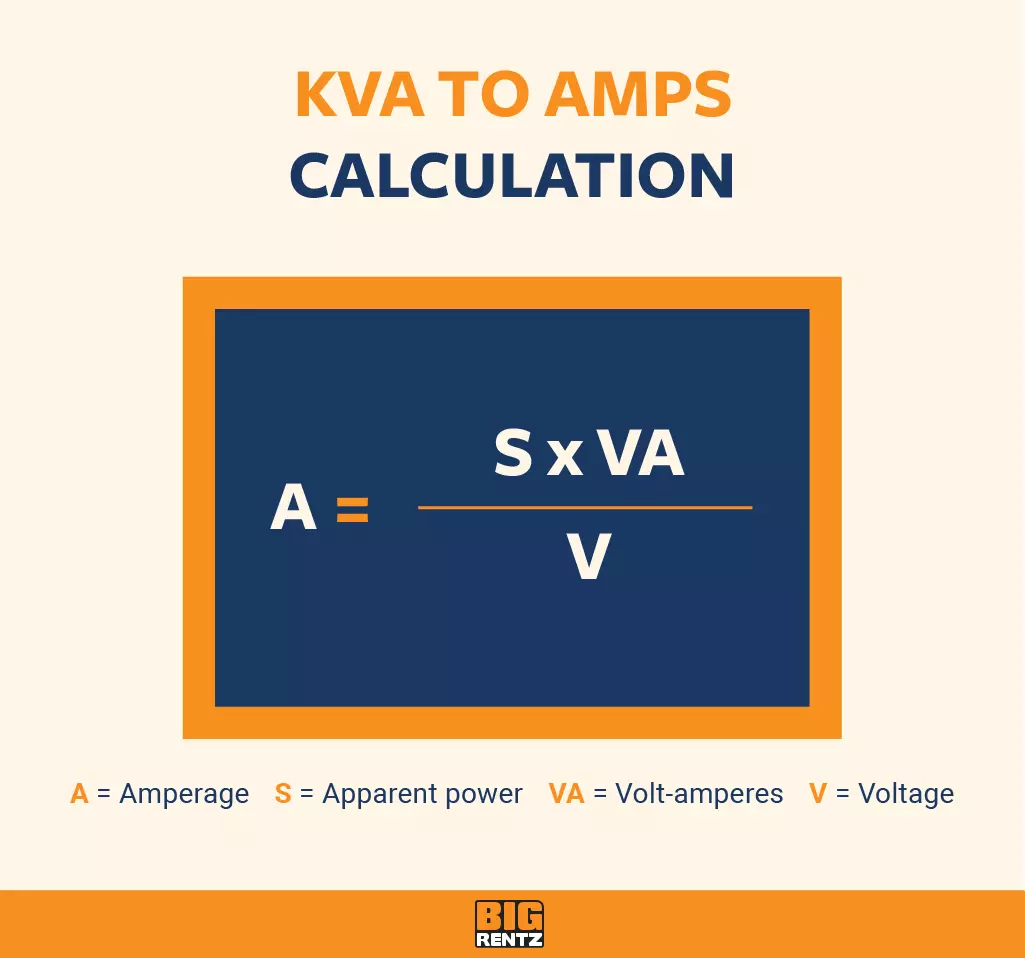
kVA to Amps Calculation
Sometimes, you may be given a kVA value rather than kW and need to convert this to amps instead. In this case, you multiply the apparent power (S) by the number of volt-amperes (VA), then divide the result by the number of volts.
A = S x VA
V
How Many Amps Does a Generator Produce?
There isn’t one set number of amps that every generator produces. It comes down to the generator’s size, the voltage you’re using and whether the system is single-phase or three-phase.
A larger generator will naturally push out more current, and when you’re working with lower voltage, the amperage goes up to deliver the same power. The type of power setup matters too, which is why the numbers can look different on a home backup unit compared to equipment used on a commercial jobsite.
Here are a few quick reference examples:
- 5 kW generator (single-phase, 240V): ≈ 21 amps
- 20 kW generator (three-phase, 208V, 0.8 PF): ≈ 69 amps
- 100 kW generator (three-phase, 480V, 0.8 PF): ≈ 150 amps
These numbers are estimates and assume typical power factor conditions. Always confirm voltage and phase before sizing cables, breakers or distribution equipment to ensure safe operation.

Choosing the Right Size Generator
When we help customers choose a generator, we start by identifying exactly what needs power. List your equipment and note both running and startup watts. Motors, compressors and HVAC systems often draw extra power at startup, so your generator should handle those brief surges comfortably to keep everything running smoothly.
It’s also smart to leave some breathing room. Adding a 10 to 20 percent cushion helps prevent overloads and gives you flexibility if you need to plug in additional equipment later. A generator that’s too small can trip breakers and slow down work, while one that’s too large may burn more fuel than necessary.
For temporary projects, events or emergency backup, renting often makes more sense than purchasing. BigRentz offers generators in a range of sizes, making it easier to scale power to your jobsite or facility without long-term ownership costs.
Common Generator Conversion Mistakes
- Ignoring Power Factor: Failing to account for power factor can lead to inaccurate calculations. Since kW reflects usable power and kVA reflects total supplied power, overlooking power factor may cause you to overestimate how much equipment your generator can actually support.
- Mixing kW and kVA: Treating kW and kVA as interchangeable is a common error. Confusing the two can result in improper sizing and unexpected performance issues.
- Assuming Single-Phase vs. Three-Phase: Using the wrong formula for your system type will produce incorrect amperage results.
- Undersizing Generators: Choosing a generator that only matches running watts, without accounting for startup surges, often leads to tripped breakers and equipment shutdowns.

Once you’ve chosen your generator and have it up and running, you’ll want to make sure it’s properly maintained. With regular maintenance, a genset can last 20 years or more.
If you’re unsure which size or configuration is right for your project, consult BigRentz for generator recommendations or rental quotes. Our team can help you match the right equipment to your power load requirements, whether you’re planning for a jobsite, event or backup application.
FAQs
How do you convert kW to amps?
To convert kW to amps, multiply kW by 1,000 and divide by voltage. For three-phase systems, divide by voltage × √3 × power factor. Always confirm your phase and power factor before calculating.
How many amps does a generator produce?
It depends on the generator’s kW rating, voltage and whether it’s single-phase or three-phase. Higher kW and lower voltage generally mean higher amperage.
What’s the difference between kW and kVA (kVA vs. kW)?
kW measures usable power that performs work. kVA measures total apparent power supplied. The difference between the two is determined by the power factor.
Do three-phase generators produce more amps?
Not necessarily. Three-phase systems distribute power more efficiently, but amperage depends on kW, voltage and configuration.
How do I size a generator for my jobsite?
Add up your total running watts, account for startup surges and include a safety margin of 10 to 20 percent to avoid overloads.