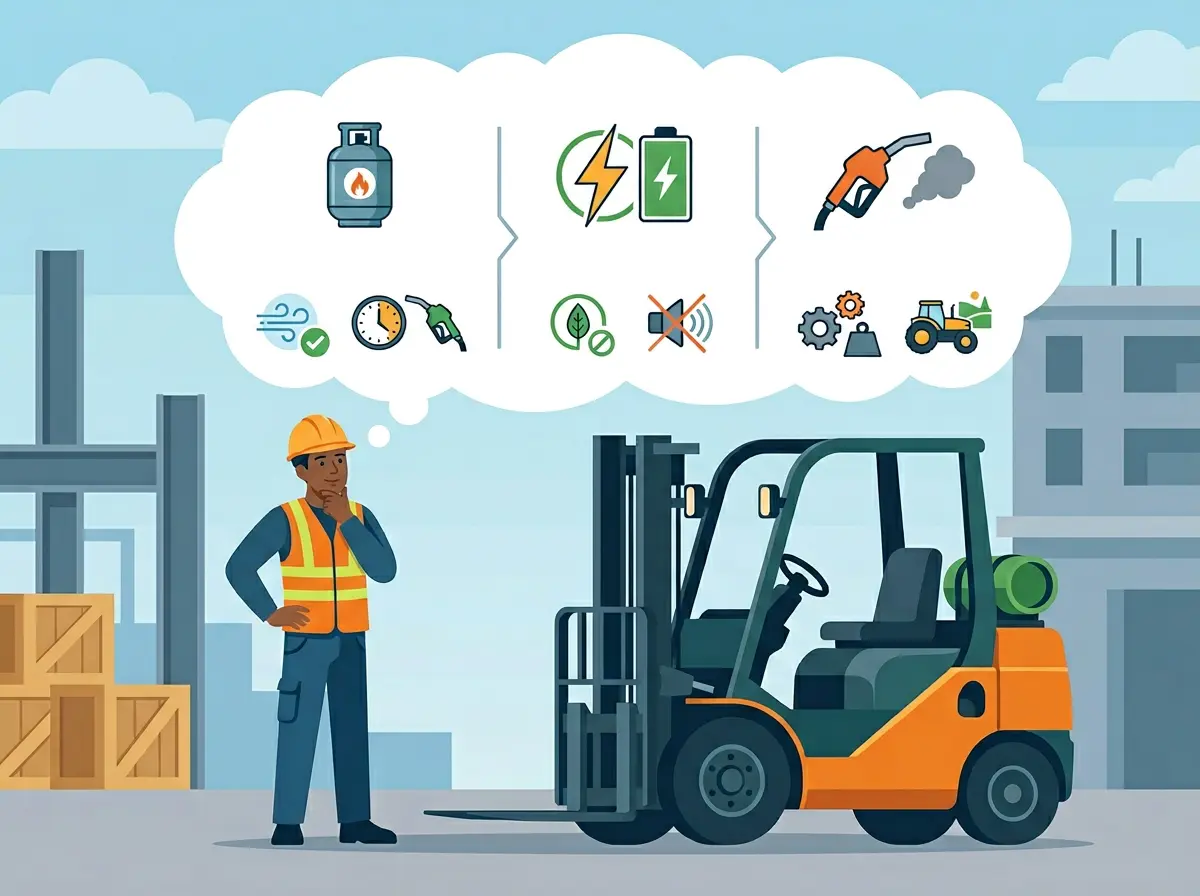
Choosing a forklift fuel type affects more than equipment specs. The choice among “Electric vs. Propane vs. Diesel” influences where the forklift can operate, how it performs in your working conditions, and what your facility will spend over time.
Whether you’re running a high-throughput warehouse or a demanding outdoor yard, the right choice depends on more than power output or purchase price alone. It requires a clear understanding of the total cost of ownership (TCO), emissions requirements, and the fueling or charging infrastructure your site can support.
Below, we compare propane, electric, and diesel forklifts across the key factors that shape long-term performance, compliance, and operating efficiency.
Indoor Use and Emissions Restrictions
Emissions requirements create some of the clearest practical differences between forklift fuel types, especially in enclosed environments where air quality and ventilation directly affect compliance with OSHA requirements.
Electric
Electric forklifts produce zero direct emissions at the point of operation, making them the most suitable option for enclosed environments with strict air-quality standards.
They are best used in cold storage facilities, food-grade warehouses, pharmaceutical distribution centers, and other indoor settings where emissions control is a priority.
Propane
Propane forklifts produce carbon monoxide during operation and are subject to federal ventilation requirements under OSHA 29 CFR 1910.178(i). They can be used inside a building, but only when the facility has adequate ventilation to keep carbon monoxide exposure within allowable limits.
The permissible carbon monoxide threshold is 50 parts per million (ppm), averaged over an 8-hour shift. Meeting that standard typically requires mechanical ventilation, properly designed HVAC support, or engineered fresh-air exchange.
Diesel
Diesel forklifts are generally limited to outdoor use because diesel exhaust can create significant exposure to carbon monoxide and particulates in enclosed spaces. In warehouses and other indoor work areas, those emissions make diesel unsuitable for routine operation.
Fire code requirements, insurance policy terms, and sustainability standards such as LEED may also restrict or prohibit internal combustion forklifts altogether. In facilities with those constraints, electric is often the most practical option.
Operating Environment: Where Each Fuel Type Works
Beyond compliance, the operating environment shapes how practical each fuel type is in daily use. Surface conditions, travel paths, and the need to move between indoor and outdoor areas all influence which forklift configuration makes the most sense.
Electric
Electric forklifts are especially well-suited to controlled indoor environments, including:
- Warehouses
- Cold storage facilities
- Food and beverage plants
- Pharmaceutical distribution centers
- Retail stockrooms
The outdoor capabilities of electric forklifts have also grown. On paved or hardpack surfaces with the right tire specification, modern electric forklifts handle conditions that earlier battery-powered machines could not manage reliably.
Propane
Propane is often the most practical choice when a forklift needs to move between indoor and outdoor settings on paved surfaces. Most use cases include:
- Loading dock operations
- Outdoor lumberyards
- Paved industrial storage yards
Indoor use still depends on ventilation that meets OSHA carbon monoxide requirements. When the choice is between an electric forklift vs. propane for mixed-use operations, propane bridges the gap between diesel’s outdoor-only constraint and the charging infrastructure that electric forklifts require.
Diesel
Diesel forklifts are best suited to outdoor sites, such as:
- Construction sites and heavy equipment yards
- Lumber and building materials yards
- Ports and container facilities
- Agricultural operations
In these environments, diesel forklifts can take full advantage of their power and runtime. Their tradeoff is that they are not a practical fit for enclosed indoor operations.
Power and Performance
Torque output, temperature sensitivity, and motor responsiveness all vary across fuel types, especially in demanding or high-frequency operations. Once site conditions are clear, the next step is to compare how each fuel type performs under the demands of the job.
Diesel
Diesel produces the highest torque output of the three fuel types. It performs consistently regardless of ambient temperature. Diesel does not degrade in extreme cold or heat, which is why it is the standard for heavy outdoor lifting.
Propane
Propane performs similarly to diesel in many standard lift applications, but with greater flexibility. With adequate ventilation, it can be used in some indoor settings where diesel cannot, and it avoids the charging requirements associated with electric fleets.
Electric
The electric forklift vs. diesel forklift performance gap is narrower than most expect on standard warehouse loads. Electric models deliver instant torque and smooth, precise control, which works best for narrow-aisle work and high-frequency pickups.
Cold Weather and Battery Runtime
When the temperature hits below freezing, most electric batteries lose 20-40% of their rated runtime. For cold storage or outdoor winter use, plan for that loss with larger battery capacity or spare units in rotation.
Fueling and Charging Logistics
Fueling and charging logistics affect uptime just as much as rated performance. Each fuel type introduces different workflow demands that can either support or slow down daily operations.
Propane
Propane cylinders can be swapped quickly with no significant downtime. Cylinders are stored on-site, and a supplier replenishes inventory regularly. No infrastructure investment is required beyond a storage area that meets fire code. A full cylinder covers a standard 8-hour shift under normal operating conditions.
Diesel
Diesel engines can be refueled from an on-site tank or a portable container. Its infrastructure requirements are minimal, though having on-site fuel storage poses a fire or spill risk that must be addressed through proper containment and handling procedures.
Electric
Compared to the other two, electric forklifts require charging infrastructure. You need to install charging stations, which occupy floor space and require an upfront capital cost. Battery type determines how well the electric forklift fits into your shift schedule:
| Lead-Acid Batteries | Lithium-Ion Batteries |
|---|---|
|
|
Most rental forklifts arrive ready to operate, but electric units require compatible on-site charging infrastructure. Confirming that compatibility before delivery helps avoid first-day delays.
Operating Costs
All three fuel types have different operating costs, which can vary widely based on local energy prices, fuel markets, forklift capacity, and duty cycle. The figures below are industry benchmark ranges that show the general cost relationships among electric, propane, and diesel forklifts, rather than fixed operating costs for every application:
- Electric: Typically, the lowest cost per operating hour at about $1.50 – 2.50 per operating hour. These figures can go down, especially where industrial electricity rates are favorable.
- Propane: Mid-range, with costs that fluctuate more directly with commodity pricing. Operating costs typically range from $3.00 – 4.00 per operating hour.
- Diesel: Often the highest cost per operating hour at about $3.50 – 5.00 per operating hour, this gap narrows when diesel prices are low.
The maintenance burden follows the same order. Electric forklifts have fewer moving parts and no engine oil, fuel filters, or exhaust system to service, which reduces the ongoing maintenance burden compared to internal combustion machines. Propane- and diesel-powered forklifts require engine maintenance on schedules comparable to those of any IC engine.
Shift scheduling introduces a cost that per-hour figures do not capture. A missed charge cycle can leave a machine unavailable at the start of the next shift — lost output that does not appear in any operating cost estimate. Propane’s quick cylinder exchange makes this kind of disruption much less likely in operations that lack disciplined battery charging procedures.
Cost-per-hour figures are useful, but they should be evaluated alongside the site constraints already discussed.
Environmental and Facility Compliance Considerations
In some facilities, sustainability standards, insurance terms, or internal operating policies can narrow the choice regardless of cost or performance. Where zero-emission requirements apply, electric may be the only viable option. Propane may produce lower greenhouse gas emissions than diesel for comparable work, but it is still not a zero-emission fuel.
Facility compliance requirements also vary by industry. Food processing plants, pharmaceutical operations, cold storage facilities, and other controlled environments often maintain stricter air-quality expectations than general industrial sites. In these settings, the issue is not just whether a forklift can technically operate in the space, but whether its emissions profile aligns with the facility’s sanitation standards, ventilation design, and internal risk controls.
Insurance carriers and site-specific safety policies can also shape equipment decisions in ways that go beyond OSHA minimums. A facility may prohibit certain internal combustion equipment to reduce exposure risk, simplify compliance, or support broader ESG and sustainability goals.
For operations working toward LEED standards or corporate emissions targets, those policies can make electric fleets more attractive even when propane or diesel would otherwise meet the basic demands of the job.
Which Fuel Type Is Right for Your Operation?
The decision ultimately comes down to matching the forklift to the site, the workload, and any non-negotiable compliance constraints.
Electric
This is the recommended option if the operating environment in your facility is enclosed, compliance-sensitive, or both. Choose electric if:
- Your facility has or can install charging infrastructure
- Operations are primarily or entirely indoors
- Your facility handles food, pharmaceuticals, or has strict air quality requirements
- Sustainability compliance or emissions reporting is a priority
- High-frequency picking in narrow aisles is the primary task
Propane
This fuel type is the best choice for operations that move items between indoor and outdoor locations. We recommend this option if your site cannot accommodate charging infrastructure.
Choose propane if:
- Your site favors simplicity in refueling forklifts, and no charging infrastructure investment is a priority.
- Operations run multiple shifts, where managing battery charging logistics is impractical
- Indoor ventilation meets OSHA CO exposure requirements.
- Your operations mix indoor and outdoor work on paved or hardpack surfaces.
Diesel
Diesel is only suited for outdoor-only applications where raw power and runtime are the priorities of your operations.
Choose diesel if:
- The machine will operate entirely outdoors or in fully open environments
- Heavy lifting on rough terrain or uneven ground is required
- Cold-weather outdoor operation is the norm
- Maximum power and runtime per fill are the priorities
Important Reminders
One of the most preventable specification errors is committing to propane before the facility’s ventilation has been confirmed as compliant. Adequate ventilation under OSHA 29 CFR 1910.178(i) requires documentation and measurement.
If you cannot confirm that CO levels in your site remain below the permissible exposure limit during operation, electric is the correct specification, regardless of what your existing equipment uses.
Before placing a forklift rental order, confirm the fuel type that best fits your site and operating conditions. BigRentz specialists can help you select the right configuration based on the environment, workload, and any compliance requirements that could affect equipment choice.
Get the Right Forklift Rental for Your Project
BigRentz offers propane, electric, and diesel forklifts through a national supplier network for both short-term and long-term rentals. If you need help choosing the right configuration for your site, our specialists can help match the equipment to your budget, operating conditions, compliance requirements, and workload.
Browse our warehouse forklift rental inventory or contact the team for guidance before placing your order.