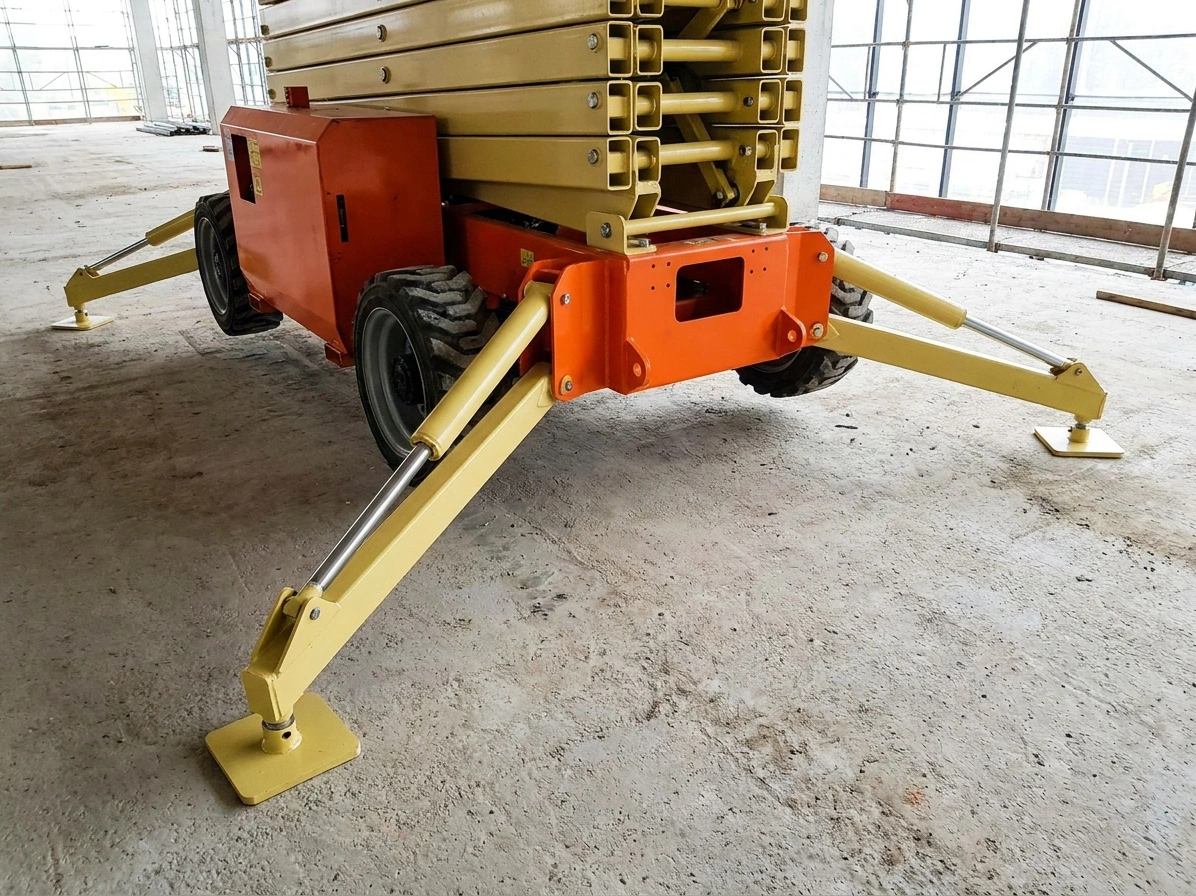
Outriggers on a scissor lift extend the machine’s effective base width to maintain stability when the standard footprint isn’t sufficient for the ground conditions or the lift height involved.
While it is a simple mechanical concept, knowing when to use a scissor lift with outriggers and how to deploy them correctly can ensure the safety and effective use of your rental. You need to know what the manufacturer requires, what the jobsite surface is doing under load, and whether the machine is set up exactly as intended.
What Outriggers Do and Which Machines Have Them
Outriggers are extendable stabilizer arms that deploy outward from the base of the scissor lift. This increases the machine’s footprint and lowers the effective center of gravity when the platform is raised. By transferring a portion of the machine’s weight and giving the platform load a wider contact area, operators can reduce the instability as the platform rises.
Not all scissor lifts have outriggers. Electric slab scissor lifts designed for smooth, level surfaces typically do not need them in controlled indoor environments. Their standard base dimensions are generally sufficient for warehouses, interior build-outs, and maintenance work where the surface is flat and consistent.
Rough terrain scissor lifts operate on outdoor job sites and in industrial work areas where uneven surfaces are the norm. That is why scissor lift outriggers are more common on rough terrain units than on indoor units.
The presence of outriggers on a machine doesn’t automatically mean they are required for every lift. Their use is often dictated by a combination of load, height, and slope.
When Outriggers Are Required
Manufacturer Specifications
The first place you should look is the manufacturer’s operating manual and load chart for the exact machine you are using. This is the primary authority on outrigger requirements. Different lifts have different operating envelopes, and these limits are based on engineering calculations for that specific model.
Some machines require outriggers when:
- The platform is raised above a stated height.
- The lift is positioned on a slope above a specified gradient.
- The load reaches a certain capacity.
If the manual or load chart says the outriggers are required for your conditions, the requirements are not optional. You can find the load chart affixed near the platform controls, lower control station, or data plate. Before you start work, confirm these details:
- Maximum platform height with and without outriggers
- Maximum allowable slope or out-of-level condition
- Load restrictions tied to outrigger use
- Wheel position requirements during deployment
- Surface or ground limitations noted by the manufacturer
Operating outside these parameters means you are no longer using the lift as rated. A machine may appear stable at ground level, but appearance is not a substitute for following the approved operating configuration.
Ground Conditions
Rough terrain scissor lifts with outriggers are most commonly deployed on construction sites, outdoor maintenance operations, and industrial sites where ground conditions can vary between compacted dirt, gravel, asphalt in variable condition, grass, or surfaces with embedded debris.
Outriggers are required or strongly recommended in various conditions:
- Unlevel Ground: A slight slope or uneven surface can shift the machine’s center of gravity toward one side. Most scissor lifts have a maximum operating slope specification of 3° to 5° for rough-terrain models.
- Soft Ground: Surfaces such as gravel, grass, and loose soil are more prone to compression under equipment weight. Outrigger pads distribute the point load over a larger area, reducing ground pressure and preventing the outrigger foot from sinking.
- Surface Irregularities: Ruts, embedded rocks, debris, or patched pavement can reduce consistent wheel contact. Outriggers help compensate for uneven support under the chassis.
Lift Height
As the platform rises, the machine’s center of gravity rises with it. At greater heights, the longer moment arm from the tipping axis to the raised load means that smaller lateral forces can cause tipping. That is why many manufacturers specify a height threshold beyond which the outriggers must be deployed.
How To Deploy Outriggers Correctly
Correct outrigger deployment is a sequence. If you skip a step in the process, you can reduce or eliminate the stability benefit the outriggers are intended to provide.
Step 1: Position the Machine on a Level Surface
Outriggers improve the stability envelope, but they do not replace site preparation. Before deployment, identify the best available setup area. Look for firm support, minimal slope, and no obvious voids, trench edges, or recently disturbed ground. If a better location is available nearby, use it.
Step 2: Extend Outriggers
Partial deployment means partial support. The machine’s rated geometry is based on a defined outrigger position, so all stabilizers need to be extended as instructed. If one arm is short or not fully engaged, the support footprint changes. On an outriggers scissor lift, uneven deployment may not be obvious from the platform, but it can affect operations once the load is at height.
Step 3: Place Outrigger Pads on Soft or Unstable Surfaces
Pads spread the load over a larger area, reducing point pressure on the ground. On concrete in good condition, pads may be optional depending on the machine and site rules. On surfaces that might compress or break down under pressure, they should be treated as necessary. The pad should sit flat and fully support the outrigger foot.
Step 4: Lower the Outrigger Feet
A foot that is just touching lightly is not yet doing the job. The feet need firm, stable contact so the load can be transferred as intended. If a foot settles into loose material or sits on an unstable object, it cannot provide reliable support.
Step 5: Verify Levelness
Most lifts include a level indicator or monitoring system. Check the machine after all outriggers are deployed. If the lift is still outside its acceptable level range, reposition it. Do not assume the outriggers have solved the problem simply because the machine looks more stable.
Step 6: Confirm Wheel Lift Requirements
Some models require the wheels to stay in contact with the ground during outrigger use. Others allow or require partial transfer onto the outriggers. The operating manual tells you which setup applies to your machine. If you guess instead of confirming, you may be changing the load path in a way the machine was not designed to handle.
Common Errors That Negate Outrigger Effectiveness
Deploying on Inadequate Ground
Outriggers can only work if the surface beneath them can support the load. Saturated soil, recently backfilled areas, trench edges, and weak asphalt are all common problem spots. A foot can sink slowly enough that the issue is not obvious at first. By the time the movement is noticeable in the platform, the machine may already be outside a safe stability margin.
Unequal Extension
If three outriggers are fully positioned and one is short, the machine may still look normal from a distance. The problem appears only when the elevated load begins acting on a footprint that is smaller on one side than the chart assumes. This is a frequent risk with scissor lift outriggers, particularly when setup is rushed.
Moving the Machine With Outriggers Deployed
Scissor lifts with outriggers deployed are not designed to travel. Even a short repositioning move can shift the contact points, damage the outrigger arms, or create a sudden instability event if a foot strikes debris or drops into a low spot. If you need to move the machine, retract the outriggers first.
Assuming Level Ground Is Stable Ground
A surface can be level and still be unstable. Compacted gravel may shift under point loads, while old asphalt may soften in heat or fail over weak base material. Evaluate whether the ground can actually bear the load.
Not Rechecking After Ground Shift
On granular or soft surfaces, the ground can change after initial setup. Once the platform is raised and the weight distribution changes, one outrigger foot may settle further than the others. If the machine feels different, if the platform becomes less steady, or if you notice any movement at the base, lower the lift and inspect the contact points before continuing.
Rough Terrain Scissor Lifts and Outriggers
Rough terrain models are built to work outdoors on surfaces that are less predictable than indoor slabs. Pneumatic tires, greater ground clearance, and heavy-duty construction make them the right choice for jobsites. However, those environments introduce more variables that affect stability.
That is why you should think differently about a rough terrain scissor lift with outriggers than you would about a slab machine used inside a warehouse. Outdoors, the ground can change with weather, traffic, excavation activity, and material staging.
A practical rule is to treat outrigger deployment as the default for rough-terrain equipment and non-deployment as the condition that requires positive support from the load chart. Do not wait for the site to look obviously bad before you consider stabilization. The risk on outdoor surfaces is often in what you cannot see immediately.
Rental customers who have used indoor lifts might assume the setup process is basically the same outdoors. However, a scissor lift with outriggers requires greater attention to the supporting surface, the machine’s rated configuration, and the deployment sequence before elevated work begins.
What To Check Before Operating
Before operating the platform, review these checks to prevent common setup failures:
- Read the manufacturer’s load chart for the specific machine.
- Identify the height and ground condition thresholds that require outrigger deployment.
- Inspect the outrigger arms and feet for damage or wear before each use.
- Assess the ground surface at each outrigger foot location for soft spots or unstable material.
- Confirm outrigger pads are available and in adequate condition for the surface type.
After deployment:
- Confirm every foot is in firm contact and properly seated.
- Check the level indicator after deployment.
- Confirm whether the wheels must remain down or be lifted per the machine’s instructions.
- Recheck contact points after raising the platform, especially on soft or granular surfaces.
Rent the Right Lift and Set It Up the Right Way
Outrigger requirements can vary, so there is no substitute for checking the operating manual and load chart before you begin work. If you are using a rough terrain scissor lift with outriggers, proper preparation and deployment can help you avoid setup errors that compromise stability at height.
If you need a lift for uneven outdoor conditions, BigRentz can help you find the right equipment for the job. Explore available scissor lift rentals, compare machine specs, and make sure you have the features your site requires before work begins.
Outrigger requirements vary by machine model, manufacturer specification, and site conditions. Always refer to the operating manual and load chart for the specific machine in use. For site-specific ground bearing capacity questions, consult a qualified engineer.