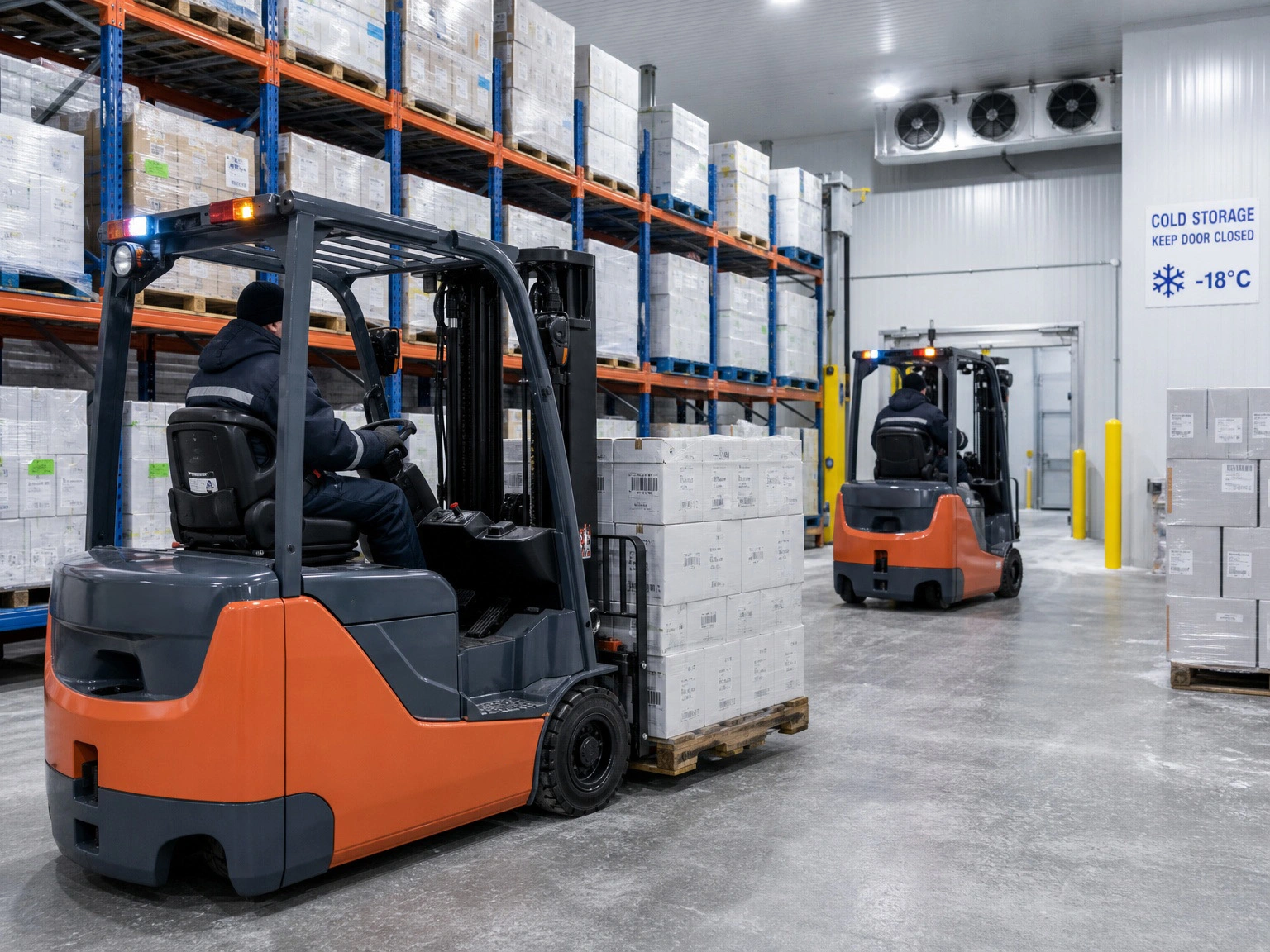
Cold storage forklift operations come with challenges that do not exist in ambient warehouse environments. In freezer and refrigerated facilities, low temperatures can reduce forklift performance, accelerate wear on key components, create traction and visibility issues, and place more physical strain on operators.
Cold storage planning goes beyond temperature control. Low-temperature environments change how forklifts perform, how quickly components wear, and how safely day-to-day operations can run.
This guide covers the main operational risks, equipment considerations, and safety factors to review before deploying a forklift in cold storage.
Why Cold Storage Is a Different Operating Environment
Cold storage puts forklifts under stresses they do not face in a standard warehouse. As temperatures drop into freezer range, battery output can decline, hydraulic systems can respond more slowly, and materials that remain flexible in ambient conditions can become stiffer and more brittle. Even when a truck is still operational, it may no longer be performing with the same consistency or responsiveness.
Common cold-storage effects include:
- Reduced battery capacity
- Slower lift and tilt response as the hydraulic fluid thickens
- Less effective lubrication in moving parts
- Increased stiffness in rubber seals, hoses, and similar components
- Added strain on electrical systems during repeated temperature shifts
Taken together, these changes can reduce forklift responsiveness, increase wear, and make performance less predictable in freezer environments.
Condensation Creates Safety and Reliability Problems
Cold storage also introduces a second challenge that standard warehouse operations do not deal with to the same degree: condensation. When a forklift moves from a freezer or refrigerated zone into warmer air, moisture can form on cold surfaces almost immediately. That includes electrical connectors, battery terminals, control panels, mast components, and the floor around the truck.
This creates problems that are easy to underestimate. Moisture can contribute to traction issues, compromise electrical reliability, and leave slick surfaces that are not always obvious at a glance. In facilities with frequent zone changes, those transition points can become a recurring source of both safety risk and equipment-related issues.
Operator Physiology Changes in the Cold
The cold affects more than the truck itself. It also changes how operators perform throughout a shift. In freezing environments, reduced hand dexterity, slower reaction times, and lower grip strength can make precise forklift operation more difficult, especially during repeated handling, stacking, and maneuvering tasks.
Even when an operator feels adequately protected, prolonged exposure to low temperatures can still affect control and responsiveness. That matters in any setting where safe forklift operation depends on clear visibility, steady input, and quick adjustments around people, racks, and product.
Equipment Selection for Cold Storage
Choosing the right cold storage forklift should start with selecting the best-suited power source. Next comes the correct tire specification. Each of these components is critical to reducing hazards in cold storage environments.
Electric vs. Internal Combustion
Electric forklifts are a better fit for enclosed cold storage because they produce no exhaust emissions. That makes them easier to operate in refrigerated and freezer areas where air circulation and indoor air quality need to be tightly controlled.
The main tradeoff is battery performance. In freezing conditions, electric forklifts can lose usable runtime compared with the same truck operating at ambient temperature, which means battery type matters.
| Battery Type | Performance at 0°F to -10°F | Best Use |
|---|---|---|
| Lead-acid | Roughly 30–50% of rated capacity | Light-duty or partial-shift cold work |
| Lithium-ion | Better retention than lead-acid, still below ambient rating | Full-shift freezer operations |
Because of that, cold storage operations often need to plan more carefully around runtime, charging, and battery changes. For longer shifts in freezer environments, lithium-ion may offer a more practical solution, though actual performance should always be confirmed against operating temperature rather than room-temperature specifications.
LP gas forklifts may still be used in some cold storage applications, particularly around loading docks or partially open freezer bays where ventilation is sufficient. In fully enclosed cold storage areas, however, electric forklifts are generally the more suitable option because ventilation requirements make internal combustion equipment harder to manage safely.
Cushion vs. Pneumatic Tires
In cold storage, the right tire choice depends largely on where the forklift will operate. For enclosed freezer and cooler areas with smooth concrete floors, cushion tires are usually the standard choice. They are better suited to indoor surfaces and generally make the most sense for internal cold storage work.
That said, freezer conditions can still affect how those tires perform. Standard cushion compounds tend to harden in low temperatures, which can reduce grip and lengthen stopping distance. For continuous freezer use, cold-rated compounds are better suited because they retain more flexibility in the cold.
If the operation also includes outdoor dock or yard activity, one tire type may not be enough. Pneumatic tires are better equipped for exterior surfaces and rougher conditions, which is why many facilities split equipment roles between indoor and outdoor use:
- Use pneumatic-tire trucks for outdoor dock and yard work
- Use cushion-tire trucks for indoor freezer and cooler operations
Battery Management in Cold Storage
Battery management becomes more complex in cold storage environments. Lower temperatures can affect both how the battery discharges during a shift and how well it accepts a charge between shifts.
Consider these battery practices in freezer operations:
- Do not charge lead-acid batteries when they are cold. Charging accelerates sulfation and cuts long-term capacity. Bring batteries to ambient temperature first, either in a dedicated charging room or by timing swaps around zone transitions.
- Expect lithium-ion to charge more slowly. Most packs will reduce the charge rate or pause charging entirely when cell temperature falls below 32°F. This means the battery is protecting itself, not failing.
- Read the state-of-charge display conservatively. State of charge drops faster than the display suggests in the cold. A 30% reading in a freezer yields less usable runtime than a 30% reading in ambient conditions.
- Set a higher minimum charge level for cold environments. A more conservative cutoff helps reduce the risk of a truck losing power mid-shift in a freezer bay.
Managing Cold-to-Ambient Transition Zones
Cold storage operations often require forklifts to move between freezer areas and warmer rooms, such as receiving bays or dry storage, throughout the day. That constant back-and-forth creates a set of operational issues that need additional planning, especially around condensation, traction, and component wear.
One of the most immediate hazards is floor moisture. When a forklift moves from a -20°F freezer into a 65°F receiving area, frost on the truck and its load begins to melt as warm, humid air hits cold surfaces. Moisture can form on the machine, on the pallet, and on the floor around the doorway, creating slip hazards that are easy to miss until someone is already in the area.
Here are a few steps to help keep this under control:
- Check and dry floors around cold-room doorways on a set schedule
- Slow forklift traffic down near the transition
- Keep foot traffic clear while forklifts are moving through
- Add heated floor strips or anti-condensation flooring at doorways used heavily during the day
Repeated temperature cycling also puts more strain on the truck itself. Rubber seals and hoses expand in warm air and contract in cold air.
Water seeps into electrical connectors during the warm pass and freezes once the truck returns to the freezer, slowly wearing down the electrical system. A forklift that stays in one temperature area for the whole shift will go longer between service visits than one that crosses back and forth all day.
Forklift Attachments for Cold Storage
The forklift itself is only part of the equation. Attachments also need to be evaluated for cold storage use, especially when low temperatures and repeated thermal cycling can affect wear, seals, and safe lifting capacity.
Forklift attachments for cold storage follow the same categories as in a regular warehouse, with additional durability and inspection considerations layered on top.
Fork Extensions
Cold chain loads often sit on non-standard pallets or slip sheets that benefit from longer forks or extensions. In a cold environment, check extensions more often for fatigue cracks at stress points. Thermal cycling accelerates metal fatigue, particularly at the weld and heel areas.
Side-Shifters
Side-shifters are useful in any warehouse, but their value is especially high in cold storage. Thick insulated gloves reduce the precision of manual positioning adjustments, so being able to nudge a load hydraulically saves time and prevents rack damage.
Clamps
Carton clamps, bale clamps, and roll clamps appear in cold storage sites where product is stored without pallets to maximize density. Perform cold-specific maintenance for hydraulic lines, fittings, and seals on the clamp body. Inspect for seal condition and fluid contamination more often than the schedule used in regular warehouse operations.
Specialty Cold-Chain Attachments
Some attachments are designed specifically for temperature-sensitive handling, including:
- Insulated fork covers that reduce thermal transfer to temperature-sensitive loads
- Carriage-mounted thermometers for product temperature monitoring during handling
These are more specialized tools, but they can be relevant in pharmaceutical cold-chain operations and high-value food distribution.
A Note on Capacity
Every attachment added to a forklift changes its safe working load. Any cold storage machine leaving the yard with an attachment installed should carry an updated capacity plate that shows the reduced safe load for that setup.
Operator Safety in Cold Storage
Cold storage affects the operator as much as the machine. While the Occupational Safety and Health Administration (OSHA) doesn’t publish cold-stress rules specific to forklift operators, the General Duty Clause still requires employers to protect workers from recognized cold hazards. Most facilities follow the ACGIH Work/Warm-Up Schedule to help structure exposure limits and break schedules.
A few operator safety issues deserve particular attention:
- PPE and Dexterity: OSHA 29 CFR 1910.138 requires hand protection matched to the task. Insulated gloves keep operators warm but reduce grip and fine motor control, which affects placement accuracy in narrow-aisle racking.
- Warm-Up and Rotation: For freezer work at or below 0°F, build rotation into the shift plan and keep warm-up rooms within a short walk of the cold zone.
- Visibility and Fogging. An operator’s breath and body heat can fog overhead guards and cab windows on enclosed trucks. Make defogging part of the pre-shift check, whether that means cab heating or an anti-fog treatment on the guard.
Maintenance Differences in Cold Storage
Equipment selection and operator protocols help a shift run smoothly, but maintenance is what keeps a cold storage forklift reliable over time.
Trucks operating in freezer environments usually need more frequent service than the same models used in a standard warehouse, and several maintenance checks become more important in the cold, such as:
- Hydraulic Fluid: Standard fluid thickens in cold. Use a cold-rated hydraulic fluid formulated for the operating range to maintain consistent lift and tilt response.
- Lubrication: Standard greases harden in the cold. Specify cold-rated lubricants at the moving parts of the mast and carriage, along with all standard grease points.
- Electrical Connectors and Terminals: Inspect for corrosion and moisture from condensation cycling. Dielectric grease helps reduce moisture ingress.
- Seals and Hoses: Shorten the inspection interval compared to a standard warehouse schedule, and pay particular attention to fittings, which take the brunt of the temperature swing.
- Tires: Cold-hardened tires wear differently from tires working at room temperature. Check compound condition alongside tread depth.
What to Confirm Before Placing a Rental Order
A rental order should reflect the real operating environment, not just a generic cold storage label. Before the truck is delivered, confirm the details that will affect performance in the freezer, in transition zones, and across the full shift.
Review the following with your rental provider:
- Operating Temperature Range: Provide the actual temperature range the truck will operate in, rather than a generic label like “cold storage.”
- Battery Chemistry: Lithium-ion or lead-acid, with expected runtime at operating temperature.
- Hydraulic Fluid Spec: Rated for the operating temperature range.
- Tire Compound: Rated for sustained cold operation.
- Transition Frequency: If the machine will cycle between cold and ambient zones, state how often. Maintenance intervals depend on it.
- Updated Data Plate: Confirm the plate reflects any attachments installed on the truck before you accept delivery.
A short conversation with the rental provider before the truck leaves the yard saves far more time than troubleshooting a poorly specified machine after it arrives.
Rent the Right Cold Storage Forklift With BigRentz
BigRentz can help manage risks when operating forklifts in cold storage facilities. Since 2012, we’ve built the largest construction equipment rental platform in the U.S., matching operators in refrigerated distribution and cold-chain logistics with the right machine the first time.
Here’s what you get when you rent through BigRentz:
- Nationwide Reach: A network of 6,000+ equipment suppliers and 14,000+ rental locations, covering 90% of the U.S. population within 30 minutes of a partner yard.
- A Proven Platform: ISO 9001:2015 certified, with more than $1 billion in rental transactions processed and a spot at #45 on the Inc. 500.
- Total Price Transparency: Daily, weekly, and monthly rates with all-in costs shown before checkout. No surprise line items at pickup.
- Rental Support When You Need It: Phone and online ordering backed by a U.S.-based customer care team, with optional Rental Protection Plan coverage on every order.
- Specialists for Complex Jobs: For cold storage operations that need extra coordination, BigRentz+ offers white-glove service with a dedicated account team.
For facility-specific compliance with OSHA cold stress standards, pair your rental with guidance from a qualified safety professional and the equipment manufacturer’s cold-environment operating instructions.
Call 855-999-LIFT or request a quote online to get a cold-rated forklift matched to your operating temperature, shift length, and attachment needs.