Clearing land is often the first step in preparing a property for use. Overgrown brush and small trees can limit access, delay development, or make routine maintenance difficult.
Whether the goal is lot clearing for a future build or targeted brush removal to reclaim usable space, selecting the right equipment is crucial.
This guide walks you through the types of land clearing equipment commonly used to remove brush and small trees across different terrain conditions. We compare equipment categories and explain what each machine is best suited for, helping you find the right equipment for your project.
Best Types of Land-Clearing Machines
Choosing the right land clearing equipment starts with understanding what you’re clearing and what the land looks like before work begins. Dense forests, overgrown lots, open fields, and uneven terrain all place different demands on machines.
This section breaks down land clearing machinery by clearing capability and terrain suitability. Each category explains what the equipment does best and the types of projects it’s commonly used for.

Equipment for Clearing Dense Forest and Large Trees
Robust machines are needed for heavy brush, mature trees, and rough terrain. These heavy-duty options bring power to clear dense vegetation and even reshape the land itself.
Bulldozers
A bulldozer is often the first piece of land-clearing machinery used on large, undeveloped sites. It utilizes a large front blade to push, topple, and pile vegetation, making it effective for quickly removing trees and debris across vast areas.
Bulldozers are best suited for undeveloped land where precision is less important than force. They work well when the objective is to open up space fast, especially before grading or infrastructure work begins.
Common Uses:
- Clearing dense forest growth ahead of development
- Initial lot clearing for large residential or commercial sites
- Removing fallen trees and surface-level roots
- Pushing debris into manageable piles
Best Suited For: Large-scale clearing where trees and heavy brush need to be removed quickly with minimal repositioning.
Excavators
Excavators offer a different approach to field clearing by combining power with control. Instead of pushing vegetation over, an excavator removes it selectively using its hydraulic arm and attachments.
This makes excavators effective when trees need to be uprooted entirely, including their root systems. They are often chosen when precise clearing is required or when debris must be lifted rather than just pushed.
Common Uses:
- Removing large trees with intact root systems
- Clearing wooded areas near structures or property boundaries
- Preparing sites that require excavation after clearing
- Selective clearing during phased development
Best Suited For: Projects where controlled removal of trees and vegetation is required, and where terrain conditions necessitate stability and reach.
Forestry Mulcher
A forestry mulcher is purpose-built brush clearing equipment designed to grind vegetation into mulch where it stands. Instead of removing material, it reduces trees and brush into a ground-cover layer. They minimize hauling and disposal while leaving behind organic material that can help stabilize soil.
Common Uses:
- Clearing overgrown lots without debris removal
- Managing vegetation for field clearing or access roads
- Reducing underbrush in wooded or rural properties
Best Suited For: Dense brush and small-to-medium trees where material can be processed on-site, including projects that may later consider land clearing mulcher rental for short-term access to specialized equipment.
The Best Equipment To Clear Brush and Small Trees
Mid-size machines balance versatility and maneuverability. They are commonly used when vegetation is established but not fully forested, or when space constraints limit the use of larger machines.
Skid Steers
A skid steer becomes highly adaptable brush clearing equipment when paired with the right attachments. Mulchers, brush cutters, grapples, and tree shears allow the base machine to handle multiple clearing tasks.
Skid steers are effective at cutting brush, handling saplings, and moving debris. Their compact footprint makes them suitable for tighter spaces or areas with existing infrastructure.
Common Uses:
- Clearing brush and small trees along fence lines
- Lot clearing for residential development
- Trail and access path preparation
- Projects requiring frequent attachment changes
Best Suited For: Versatile clearing needs across varied terrain, where one brush clearing machine must handle cutting, lifting, and cleanup.
Tractors
Tractors equipped with brush hog mowers or clearing attachments are widely used for clearing fields and maintaining rural land. They focus on cutting vegetation rather than uprooting it.
While tractors are not designed for large trees, they efficiently manage regrowth and smaller woody material. They require stable ground and sufficient turning space to operate safely and efficiently.
Common Uses:
- Reclaiming overgrown agricultural fields
- Maintaining large rural properties
- Clearing brush ahead of fencing or planting
- Managing vegetation growth over time
Best Suited For: Ongoing maintenance and large-area clearing where cutting vegetation is the primary goal and soil disturbance is minimal.
Backhoe Loaders
A backhoe loader combines front-loader pushing power with rear digging capability, making it a practical option when clearing involves both surface vegetation and below-ground obstacles. This dual functionality allows a single machine to manage brush and small trees while also addressing roots or shallow stumps.
Backhoe loaders are often chosen for smaller projects that require multiple tasks to be completed without requiring additional equipment. They perform best on semi-developed sites with firm ground and open access, while soft soil and densely forested terrain typically call for more specialized machines.
Common Uses:
- Clearing small parcels before construction
- Removing brush and isolated trees
- Projects requiring trenching after clearing
- Utility and infrastructure preparation
Best Suited For: Multi-purpose projects where clearing, digging, and material handling are all required on a limited site.
| Heavy-Duty and Medium-Duty Clearing Equipment | |||
|---|---|---|---|
| Equipment | Best for Clearing | Terrain Suitability | Common Uses |
| Bulldozer | Large trees and dense brush; pushing, uprooting, and grading | Tracked; stable on rough or uneven ground; requires open space | Large-scale land clearing, road building, firebreak creation, initial land grading |
| Excavator | Uprooting trees; removing stumps and boulders with precision | Tracked; effective on slopes and uneven terrain; reaches confined areas | Construction prep, selective tree removal, precision clearing near structures or waterways |
| Skid Steer Loader | Thick brush and small trees using mulcher or cutter attachments | Wheeled or tracked; highly maneuverable; tracks handle soft or muddy ground | Home lots, trails, fence lines; brush cutting, hauling debris, light land clearing |
| Backhoe Loader | Small trees and brush; pushing with loader and digging roots | Wheeled; best on firm, level ground; limited in deep mud | Farm and homestead clearing; building site prep requiring digging and clearing |
| Tractor | Tall grass, weeds, light brush, and saplings | Wheeled; ideal for open fields and gentle slopes | Pasture restoration, field maintenance, right-of-way clearing on farms |
| Forestry Mulcher | Shredding brush and mid-size trees into mulch on site | Typically tracked; handles wooded, uneven terrain (avoid steep grades) | Overgrown lot clearing, forestry management, mulching undergrowth without debris hauling |
Best Types of Brush-Clearing Machines
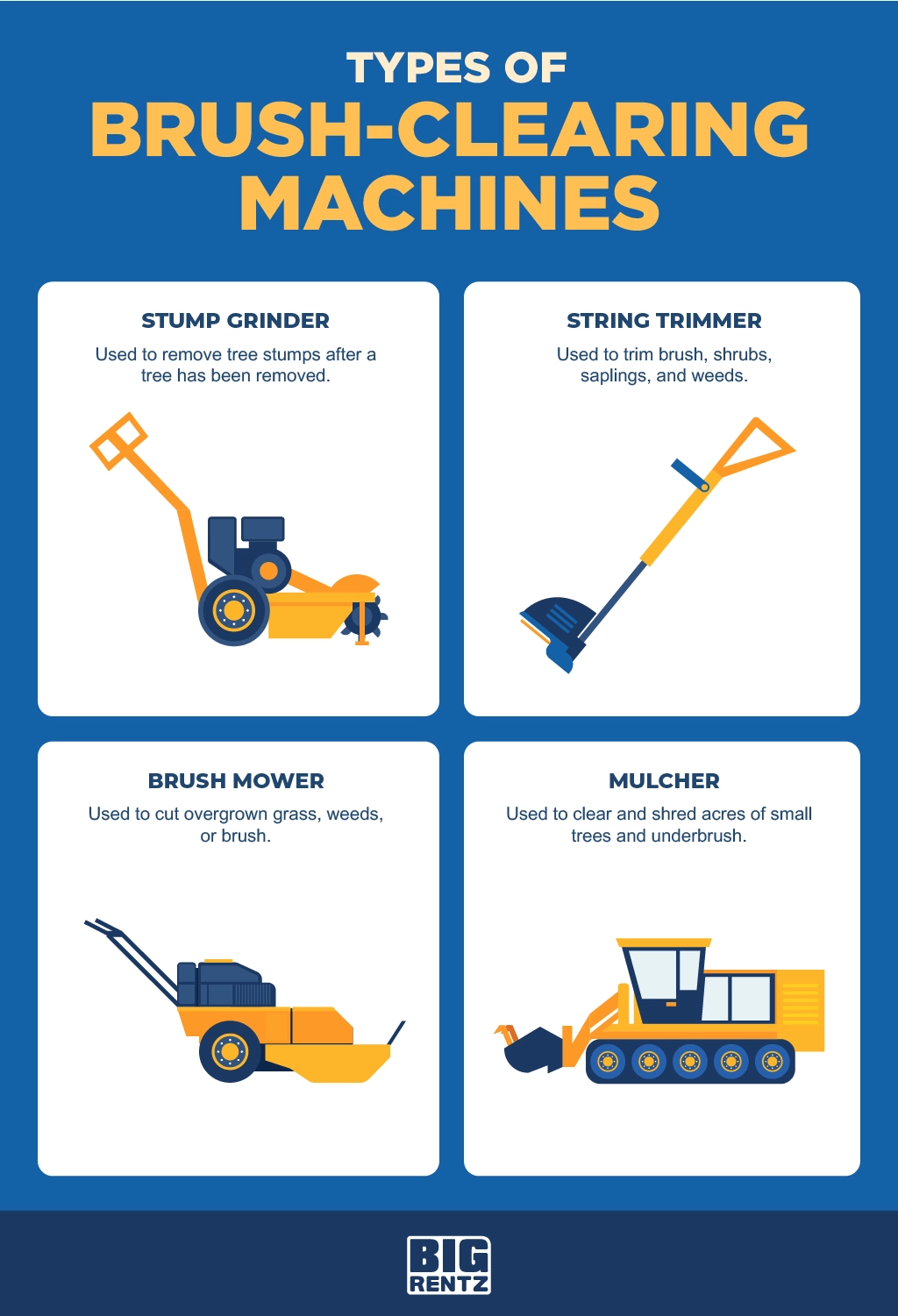
For lighter vegetation, such as tall grass, weeds, vines and very small brush, smaller machines or handheld tools are often the most practical. These tools focus on mowing or trimming vegetation in detail, often as a finishing step after larger clearing or for ongoing upkeep.
Brush Mowers (Brush Hogs/Field Mowers)
A brush mower is designed to cut through thick grass, weeds, and light brush that standard mowers cannot handle. It is commonly used where vegetation density is high but tree removal is not required.
Brush mowers perform best on open terrain with manageable slopes. They are often attached to tractors or skid steers for added reach and stability.
Common Uses:
- Maintaining cleared land
- Managing roadside or fence-line growth
- Reducing fire fuel loads
- Preparing land for future development
Best Suited For: Light brush management and surface-level vegetation control when maintaining cleared land or managing regrowth across open areas.
String Trimmers
Also known as brush cutters, string trimmers are handheld tools used for precision work. They enable operators to access areas that are inaccessible to machines.
Terrain suitability is broad, as trimmers can be used on slopes, uneven ground, and confined spaces.
Common Uses:
- Clearing around structures or obstacles
- Finishing work after machine clearing
- Managing vegetation along edges
- Small-scale maintenance tasks
Best Suited For: Detail work and supplemental clearing where machines cannot operate efficiently.
Finishing Touches: Stump Grinders
A stump grinder completes the clearing process by removing tree stumps left behind after cutting or uprooting. It grinds stumps below ground level without extensive excavation.
Stump grinders are used across various terrains, depending on the model size. They are essential when land needs to be fully usable for construction or landscaping.
Common Uses:
- Removing stumps after tree clearing
- Preparing land for foundations or paving
- Eliminating hazards in cleared areas
Best Suited For: Final-stage clearing when land needs to be free of surface and below-ground obstructions, especially on projects where brush clearing equipment rental is used to address remaining stumps or roots.
| Light-Duty and Specialized Clearing Tools | |||
|---|---|---|---|
| Equipment | Best for Clearing | Terrain Suitability | Common Uses |
| Brush Mower | Tall weeds, thick grass, briars, and saplings up to a few inches thick | Flat or gently sloping terrain; tractor or skid steer attachments handle rough ground | Field and pasture clearing, roadside and trail maintenance, wildfire fuel reduction |
| String Trimmer | Weeds, vines, and very small brush in tight or delicate areas | Handheld; usable on slopes, rocky areas, and wet ground reachable on foot | Detail cleanup around fences, trees, and buildings; garden clearing and touch-ups |
| Stump Grinder | Tree stumps; grinds below ground level | Small wheeled units for yards; larger attachments for rugged terrain | Final stump removal; site prep for construction or replanting |
What To Consider for a Land-Clearing Job
Determining how to clear land of small trees and brush begins with understanding site conditions and the project’s requirements. Asking the right questions helps you narrow your equipment options and avoid over- or undersizing machines.
A helpful starting point is to step back and ask:
- What type of land clearing machine will you need?
- Will you need a permit to clear the land? Factors such as soil, animals, vegetation, or property landmarks may prevent you from clearing the land.
- Will the type of trees you are clearing require additional tree removal equipment?
- What piece of land are you clearing?
- What material will you need to clear away? Unwanted or fallen trees? Large rocks? Overgrowth of brush and weeds?
Answering these questions makes it easier to match equipment capability to real clearing needs.
Land-Clearing Techniques

Depending on the terrain you need to clear and the kind of vegetation or other debris you’re facing, you’ll need to consider different land-clearing techniques, as well.
Cut and Grind
This is a three-step process of removing the weeds and brush first, then cutting down trees, which are then placed into a big pile to transfer them to either a dumpster or another forest.
The first step is removing the small vegetation such as tall grass, weeds, or brush. This creates space to cut down trees, which is the second step. This step requires using heavy machinery such as an excavator or backhoe to bring the trees down. Afterward, the remaining trunks and logs are placed into a pile, which are then transported to a dumpster or nearby forest.
Pushover
You can use large machinery to bulldoze and completely remove brush and large trees and by pushing them over. The success of this approach will depend on how big the obstacles are and how tough the machinery is, so if you’re renting a bulldozer, for example, check to see what it’s capable of. If you’re going to be pushing over trees, you’ll want to know how big they are and how deeply rooted they are before proceeding.
Hand Clearing
You can clear your land by using chainsaws, axes, hand tools, etc. This option is time-consuming and labor-intensive, but it’s also the least expensive method. Again, a lot will depend on what kind of clearing you have to perform. Dense undergrowth, large boulders, and other material may not be conducive to hand clearing, and heavy equipment such as dozers, backhoes, or skid steers may be needed to address such obstacles.
Forest Mulching/Moving
This method is shredding and clearing out heavy vegetation, such as underbrush and small trees, without causing damage to the environment.
The process requires using a forest mulcher to clear out any vegetation in the forest. You won’t be damaging the environment and vegetation as much; instead, you are putting it back into the ground.
Put the Right Equipment To Work With BigRentz
Land clearing works best when equipment decisions are made with purpose, not guesswork. If you’re weighing equipment choices or want a second set of eyes on your plan, BigRentz is ready to help.
Our team helps you identify the right equipment for your site and connects you with rental options through our nationwide network. Reach out to BigRentz for guidance and secure the heavy equipment you need to keep your project moving forward.