Choosing the wrong forklift configuration can create problems long before the machine ever lifts a load. For crews and site supervisors, the real issue is not just efficiency. A mismatched indoor or outdoor forklift can affect traction, air quality, maneuverability, and overall jobsite safety.
A cushion-tire model may struggle on gravel or broken pavement, while a diesel unit can create ventilation concerns in enclosed spaces. In both cases, the machine may have the right capacity but the wrong setup for the environment.
In this guide, we help you determine what type of forklift is best for indoor use and outdoor applications. The answer starts with four variables: tire type, power source, ground clearance, and operating temperature.
Why the Distinction Matters
The difference between an indoor and an outdoor forklift is not just about size or capacity. While those specs are important, they do not determine whether a machine is truly suited to a warehouse floor, a yard, or a mixed-use site.
Tire Type
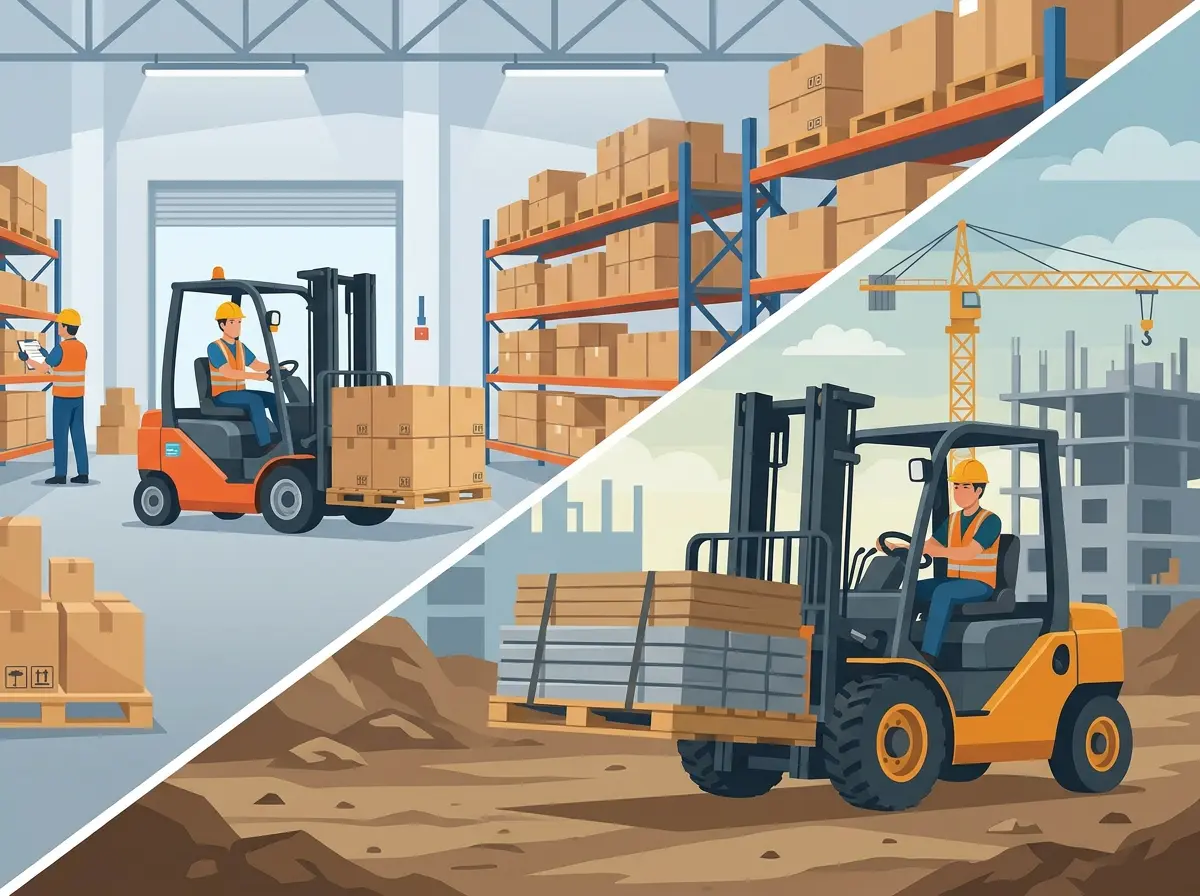
Tire type is often the clearest dividing line. An indoor forklift usually runs on cushion tires, which are designed for smooth concrete, tighter turning, and controlled indoor travel.
By contrast, a forklift for outdoor use typically uses pneumatic tires that provide more traction and shock absorption on gravel, dirt, and uneven pavement.
A mismatch reduces performance while creating tip-over risk on rough surfaces or causing progressive floor damage on smooth ones.
Power Source
Where the forklift operates matters just as much as what it lifts. In enclosed environments, electric power is often the better fit because it supports indoor air quality and quieter operation.
Outdoors, internal combustion models are often favored when longer runtime, refueling speed, and heavier-duty performance are more important.
Ground Clearance
Ground clearance determines how well the forklift handles surface changes. Low-clearance indoor forklifts can operate efficiently on flat floors but struggle on ramps, over debris, or on broken pavement. On the other hand, an outdoor forklift is built with greater clearance to handle uneven terrain more safely.
Operating Temperature
Temperature includes more than outdoor weather. Cold, heat, humidity, and repeated movement between thermal zones can affect performance, especially with electric equipment.
Tire Type: The Most Consequential Variable
The tire type is often the clearest dividing line when comparing indoor and outdoor forklift setups. It shapes where the machine can travel safely and how efficiently it moves through the workspace.
Cushion Tires
Cushion tires are made with solid rubber and designed for a compact profile. This makes them best suited for finished indoor surfaces, such as concrete warehouse floors. They offer a tighter turning radius, helping operators move more efficiently through narrow aisles and denser storage layouts.
Because cushion-tire forklifts sit lower to the ground, they also benefit from a lower center of gravity on smooth surfaces. That can support stable handling indoors, but the same design becomes a limitation on rough ground.
An indoor forklift rental with cushion tires is usually the right fit for:
- Warehouses
- Factories
- Indoor loading areas
- Smooth, level concrete floors
They are generally not rated for:
- Gravel yards
- Construction sites
- Uneven pavement
- Soft ground or debris-heavy surfaces.
Pneumatic Tires
Pneumatic tires are larger and more rugged, built for uneven terrain. Whether air-filled or solid pneumatic, they provide better traction, more shock absorption, and more ground clearance than cushion tires. This design helps the forklift move more confidently across gravel, dirt, ramps, and outdoor work zones.
That said, the tradeoff is maneuverability. Pneumatic-tire forklifts need more room to turn and are less efficient in tight indoor aisles.
A pneumatic-tire outdoor forklift rental is often better suited for:
- Lumber yards
- Outdoor storage areas
- Construction sites
- Mixed-use facilities with frequent indoor-outdoor transitions
They are often a poor fit for:
- Tight warehouse aisles
- Highly polished indoor floors
- Operations where maximum maneuverability is the priority
Power Source Compatibility by Environment
Power source is another major factor separating outdoor and indoor configurations. In most cases, the decision comes down to two competing needs: protecting air quality in the work environment and getting enough runtime and torque for the job.
Electric (Battery): Indoor Preferred
Electric forklifts are usually the best fit for indoor operations because they produce no tailpipe emissions. Their cleaner operations support indoor air quality and create a more comfortable environment for operators and nearby workers.
They also make the most sense when shifts are predictable, and charging access is built into the workflow.
LP Gas (Propane): Indoor With Ventilation Only
Propane forklifts sit in the middle. They offer flexible runtime, quick refueling, and solid lifting performance, which is why they remain common in mixed-use operations. They are especially common in facilities that move between indoor work areas and loading zones with access to outside air.
However, propane machines still produce combustion emissions, including carbon monoxide and nitrogen oxides. They should only be used indoors when ventilation is properly evaluated and compliant with safety requirements.
Diesel: Outdoor Only
Diesel forklifts are best suited for heavy-duty outdoor work where torque, runtime, and durability are required for operations. They are commonly used on construction sites and across industrial loading areas that demand consistent performance over long shifts.
What makes diesel effective outdoors is also what limits its use. Diesel engines are generally considered an outdoor-only solution because they produce exhaust that contains particulates and other pollutants. These are not safe for enclosed indoor environments and can quickly create air quality and safety concerns, even in partially enclosed areas.
Compressed Natural Gas: Treated Like LP
Compressed natural gas may burn cleaner than some other internal combustion fuels, but it still produces emissions. For that reason, it should be approached much like propane: acceptable in ventilated spaces, but not the best choice for fully enclosed indoor environments.
How Outdoor Temperature Affects Electric Forklift Performance
Many rental buyers focus on lift capacity, tire type, and expected runtime, but those numbers do not tell the full story if the electric forklift will operate in cold or high-heat conditions.
Cold Weather Reduces Available Battery Capacity
Battery chemistry slows down as temperatures drop. The forklift may still run normally, but available capacity can fall, shortening runtime and affecting charging behavior.
Lead-acid batteries are more sensitive to cold than lithium-ion systems. Around 32°F (0°C), a lead-acid battery may retain only about 75% of its normal capacity. In much colder conditions, such as -4°F, capacity can fall to roughly 50% to 60%.
Charging also becomes more difficult in freezing conditions, which is why lead-acid batteries are often stored and charged in warmer areas.
Lithium-ion batteries generally perform better in the cold. They tend to hold more usable power at lower temperatures. Still, they are not immune to temperature-related losses, and many rely on built-in heating or thermal management to maintain reliable output.
Heat Speeds Up Long-Term Battery Wear
Heat creates a different challenge. It may not reduce immediate runtime as clearly as cold does, but prolonged exposure to high temperatures can accelerate battery degradation. Hot charging environments and repeated use in high-heat settings can shorten battery life even when day-to-day performance seems steady.
With that, the goal is not to avoid electric forklifts in extreme temperatures, but to plan for them.
- If your site operates in cold weather, you may need to choose lithium-ion batteries or use heated charging areas.
- If your site regularly operates in high heat, it may mean protecting the battery from sustained exposure to heat and ensuring charging occurs in a shaded area.
Application Guide: Matching Configuration to Site Type
The best forklift configuration depends on the site. Surface conditions, travel paths, exposure to weather, and ventilation constraints all shape what will work well — and what may create problems later.
Warehouse and Distribution Center
Warehouses and distribution centers offer the most controlled environments. Smooth concrete floors and enclosed operating areas make maneuverability, indoor air quality, and efficient use of space more important than rugged terrain capability.
- Recommended Forklift: Electric forklifts with cushion tires, or a reach truck/VNA model for tighter aisle layouts
- What To Avoid: Pneumatic-tire forklifts, diesel models, and other outdoor-oriented configurations that add bulk or create emissions issues indoors.
Construction Site and Outdoor Yard
Construction sites and yards demand a much tougher setup. Gravel, dirt, mud, uneven pavement, and debris-heavy staging areas require higher ground clearance and a machine built for rougher travel.
- Recommended Forklift: Pneumatic-tire forklift, typically diesel-powered, with outdoor-rated clearance and durability
- What To Avoid: Cushion-tire forklifts, low-clearance indoor models, and narrow-aisle machines not designed for rough or uneven terrain.
Agriculture, Nursery, and Outdoor Retail
These sites involve dirt, grass, mulch, wet ground, and paved sections within the same shift. Some also include barns or partially enclosed structures, which makes the power-source decision more complex.
Buyers should also consider load type, since plant racks, longer materials, and awkward loads may require attachments.
- Recommended Forklift: Pneumatic-tire forklift with a power source matched to how much of the work is outdoors (versus in covered areas)
- What To Avoid: Cushion-tire indoor forklifts and configurations not suited to wet, soft, or uneven ground.
Mixed Indoor/Outdoor Operation
Mixed-use sites are often the hardest to spec because they require compromise. The forklift may need to move between warehouse floors, loading docks, paved yards, and rougher exterior areas within the same day.
- Recommended Forklift: Versatile pneumatic-tire configuration chosen around the primary surface and travel path; electric or propane, depending on the environment
- What To Avoid: Pure indoor forklifts used in yard conditions, or oversized outdoor machines that sacrifice too much maneuverability inside.
Paying Attention to What Happens at the Handoff Point
One of the easiest areas to overlook is the transition zone between indoor and outdoor operations. A facility may have the right forklift in the warehouse and the right one in the yard, yet still run into problems where those environments meet. Common handoff points include loading docks, covered bays, and ramps where both machines travel.
These spaces deserve closer attention because they rarely function like fully indoor or fully outdoor environments. A cushion-tire forklift may lose traction on wet surfaces or broken pavement. Similarly, a diesel unit may be effective in the yard but create air quality concerns if it idles in a poorly ventilated bay.
Before placing an indoor or outdoor forklift rental order, evaluate each transition point as its own operating zone. Look closely at the surface condition, slope, debris exposure, and ventilation. Many configuration mismatches show up here first.
What To Check Before Placing a Rental Order
Before placing a forklift rental order, it helps to step back from the spec sheet and look closely at the jobsite itself. The right configuration becomes clear once you define where the machine will travel and what kind of air environment it will operate in.
This short pre-rental check can help you prevent mismatches and avoid safety issues or avoidable rental charges:
- Identify every surface the forklift will travel on, including transition points, ramps, dock plates, and loading areas.
- Confirm whether the environment is fully enclosed, open-air, or mixed. This is often the deciding factor for which power sources are appropriate.
- If you are considering electric equipment for outdoor or mixed-use applications, check average operating temperatures. It’s also best to confirm the battery chemistry, charging needs, and expected cold-weather runtime with the rental provider.
- Measure the narrowest aisle or travel path the machine must clear, and compare it against the forklift’s total width with load.
- For outdoor use, verify ground clearance against slopes, broken pavement, gravel, and other site conditions.
- For mixed environments, confirm that ventilation in the indoor portion is sufficient for LP gas operation if applicable.
If you are unsure which setup fits, describe the environment and surface conditions to your rental provider. The configuration decision becomes easier once those inputs are clear.
Find the Better Fit for Your Site at BigRentz
If you are weighing an outdoor or indoor forklift rental, BigRentz can help you narrow down the options based on your operating environment and job demands. With years of experience supporting projects across industries, we help you find the right forklift easily.
Browse our available forklifts or start your rental with BigRentz today.