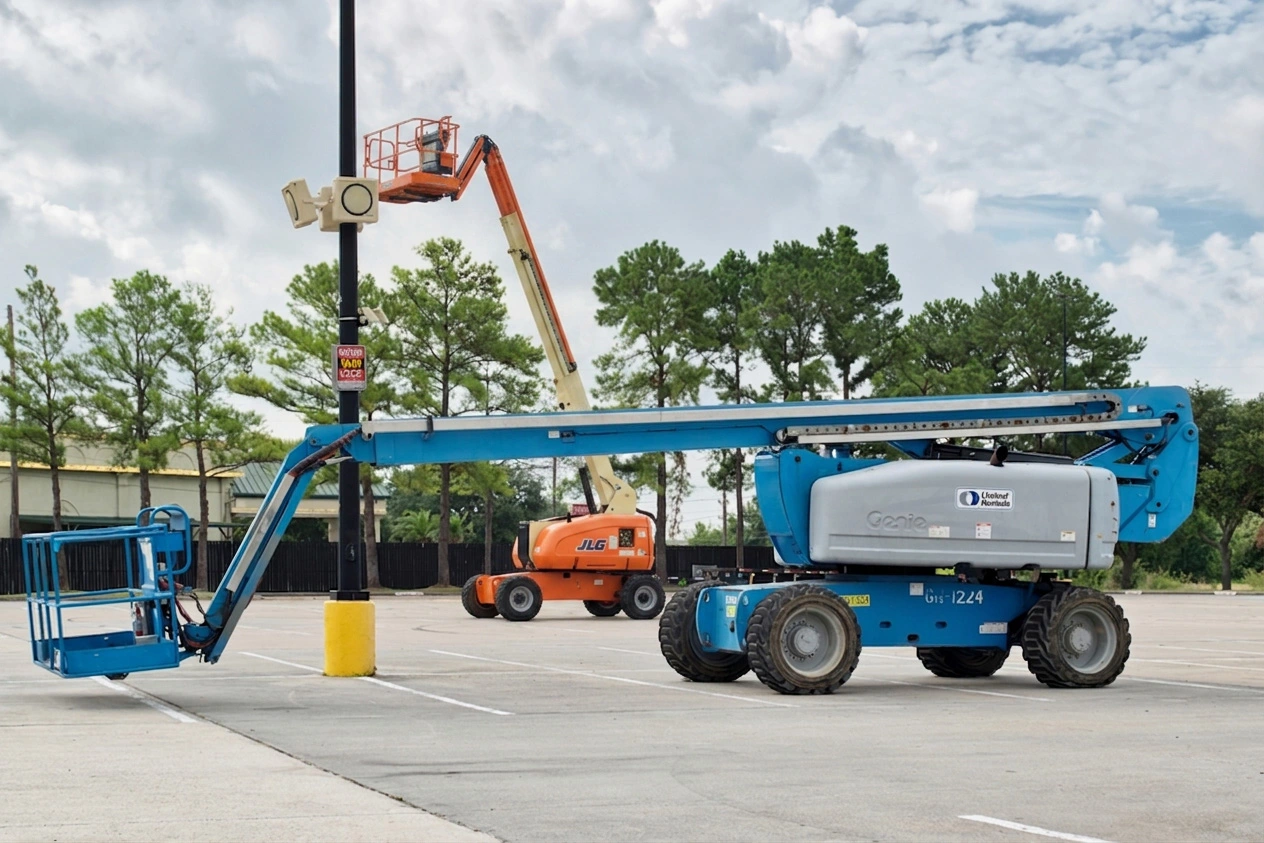
Maximum platform height is not the only metric that matters when renting a boom lift. On most commercial jobsites, the decision ultimately centers on two primary manufacturers: JLG and Genie.
While both brands build extensive lines of high-reach machinery, they approach horizontal outreach, power distribution, and chassis design from distinct engineering perspectives. These differences directly dictate ground-level performance, where the specific layout of your jobsite always outranks brand preference.
JLG vs. Genie Boom Lift: Quick Comparison
Evaluating an aerial lift fleet requires an analysis of product depth and functional design, rather than a reliance on baseline specifications. This overview outlines how the core offerings of both brands align across primary commercial rental categories.
| Equipment Class | JLG Core Design Approach | Genie Core Design Approach | Common Rental Applications |
|---|---|---|---|
| Articulating Models | High intermediate pivot points for clear up-and-over clearance | Rapid primary riser deployment and fast Z-boom positioning | Facility maintenance, HVAC installations, indoor industrial piping |
| Telescopic Models | Rigid structural steel designs focusing on high capacity envelopes | Synchronized wire-rope boom extension for smooth pathing | Exterior glazing, structural steel erection, infrastructure projects |
| Electric Lifts | Direct DC electric wheel drive systems for long duty cycles | Fuel-electric hybrid setups for indoor and outdoor flexibility | Data centers, cleanrooms, multi-phase commercial construction |
| Towable Access | Simplified mechanical outriggers with compact footprints | Integrated trailer chassis balances with centralized towing | Light commercial painting, residential tree care, facility management |
JLG frequently emphasizes high platform capacities and distinct boom structural options, while Genie emphasizes operator-centric control uniformity, rapid boom deployment sequences, and efficient transport dimensions that simplify regional hauling. Both manufacturers cover the full spectrum of reach requirements, from compact 30-foot maintenance lifts to ultra-high-reach models exceeding 150 feet.
Understanding the Different Boom Lift Categories
Selecting an aerial work platform requires matching the equipment category to the physical constraints of your workspace. Project managers typically establish the machine class before determining the specific manufacturer.
Articulating Boom Lifts
Articulating models feature multi-section booms with intermediate pivot points, commonly referred to as knuckles or elbows. This design allows the operator to elevate the platform up, over, and behind structural obstructions like pipe racks and roof trusses.
Because the upper boom sections move independently of the lower riser, positioning the platform around obstacles requires fewer changes to the chassis position. These units operate effectively in crowded industrial plants and complex architectural interiors where a straight line of sight is unavailable.
Telescopic (Straight) Boom Lifts
Telescopic booms extend in a straight line from the base turret. They offer maximum horizontal outreach, allowing your crew to work on facades or structures from a distanced staging area, such as a perimeter setback or foundation ditch.
Straight booms provide high structural rigidity and stable platform positioning at extreme heights, making them the industry standard for open-air infrastructure projects and heavy masonry work.
Towable Boom Lifts
For projects requiring frequent mobility or limited transportation budgets, towable models offer a practical alternative to self-propelled machines. These units are mounted on standard trailer chassis equipped with integrated hitch assemblies and mechanical outriggers.
While they lack independent drive tracking on-site, they offer rapid transport capability using standard utility vehicles, making them highly efficient for light maintenance and multi-site installations.
Electric Boom Lifts
Electric configurations utilize heavy-duty industrial battery banks to power electric drive motors and hydraulic pumps. Operating with zero emissions and minimal acoustic output, these machines protect air quality on sensitive indoor floor plates. Data centers, cleanrooms, and food manufacturing plants routinely mandate these quiet, non-marking units for all overhead asset maintenance.
Rough Terrain Boom Lifts
Rough terrain units are engineered specifically for harsh, unpaved environments. High-output diesel engines power heavy-duty four-wheel-drive systems equipped with oscillating axles and foam-filled tires.
Meanwhile, the wide chassis footprint stabilizes the boom when traveling across uneven slopes, keeping work moving forward before concrete slabs are poured. These features allow the machine to navigate deep mud, unpaved grades, and unstructured earth during early-stage commercial development.
JLG Boom Lift Product Line Overview
The JLG boom lift design philosophy balances high structural capacity with component durability. JLG organizes its fleet into specialized series engineered for heavy steel erection, refinery work, and shipyard maintenance.
When evaluating a JLG aerial boom lift, the machine’s load-sensing system dictates its active reach boundaries. Many modern units feature dual-capacity configurations that automatically adjust the operating envelope based on platform weight. This configuration allows operators to carry heavier tools on straight-line vertical lifts without triggering automated system cutouts that interrupt production.
JLG models use clear nomenclature based on platform height and drive type, allowing procurement teams to easily choose between compact electric warehouse units and massive rough-terrain diesel machines.
Genie Boom Lift Product Line Overview
The Genie catalog emphasizes operational uniformity and precise hydraulic performance. Arranging a Genie boom lift rental provides access to machines featuring standardized control configurations. This standardization minimizes on-site training requirements when operators transition between different Genie boom lift sizes.
Genie divides its models into Z-boom (articulating) and S-boom (telescopic) classes. Key engineering advantages include compact stowed dimensions, allowing mid-range units to ship on standard trailers without requiring wide-load highway permits.
For sensitive ground conditions, select rough-terrain models offer the specialized TraX track-drive system, which replaces wheels with four independent rubber tracks to reduce ground pressure without reducing travel speed.
Comparative Analysis Between JLG and Genie Units
JLG Articulating Boom Lift vs. Genie Articulating Boom Lift
Comparing a JLG articulating boom lift against a Genie equivalent requires assessing up-and-over clearance paths and steering geometry. While both machine classes elevate operators over structural barriers, they complete the movement through different mechanical paths.
| Operational Metric | JLG Articulating Approach | Genie Articulating Approach |
|---|---|---|
| Up-and-Over Reach Paths | Designed with a high intermediate pivot point. This configuration provides critical clearance when operators must reach over structural bulkheads, parapet walls, or elevated obstacles. | Utilizes a distinct riser geometry that allows the operator to elevate the primary riser vertically while the upper boom remains retracted. This enables rapid vertical ascent along flat interior walls without frequent secondary adjustments. |
| Steering and Maneuverability | Focuses on tight inside turning radii and highly responsive drive controls, allowing operators to navigate narrow corridors and complex industrial machinery layouts efficiently. | Integrates zero tailswing designs across compact and mid-range lines. The counterweight does not extend past the chassis footprint during turret rotation, minimizing the risk of structural impacts in confined warehouses. |
JLG Telescopic Boom Lift vs. Genie Straight Boom Models
For projects requiring direct straight-line extension to high structures, comparing a JLG telescopic boom lift with Geie’s straight S-boom line centers on horizontal outreach efficiency and platform stability.
| Operational Metric | JLG Telescopic Approach | Genie Telescopic Approach |
|---|---|---|
| Horizontal Outreach Envelopes | Utilizes heavy, ultra-rigid structural steel boom sections. This engineering focus minimizes mechanical deflection (flexing) at long extensions, giving operators maximum stability at the extreme outer edges of the reach diagram. | Employs a synchronized boom extension system. This mechanism distributes weight evenly across the chassis as the operator extends the boom, providing a remarkably smooth, consistent pathing sequence. |
| High-Capacity Structural Use Cases | Frequently favored on heavy infrastructure projects, bridge inspections, and industrial refinery upgrades, where lifting substantial capacity at long horizontal distances is the primary operational requirement. | Incorporates an intuitive dual-envelope capacity system that automatically adjusts reach boundaries based on platform weight, providing a reliable platform for tasks like exterior glazing and commercial facade installations. |
Electric Boom Lift Options for Indoor and Low-Emission Projects
Sensitive indoor environments require low-noise, zero-emission operation. While scissor lifts handle direct vertical access, electric boom lifts are necessary to reach up and over ground-level obstructions.
- JLG Electric Boom Lifts: Use direct-current (DC) drive systems with independent wheel motors. This eliminates traditional hydraulic power loss, significantly extending battery life and maintaining ramp gradeability across full shifts.
- Genie Hybrid/DC Lifts: Offer dual-source adaptability by pairing a diesel generator with an electric battery bank. Operators can run on pure electric power indoors, then switch to hybrid mode outdoors to recharge the system during multi-phase transitions.
Towable Boom Lift Comparison
When evaluating a Genie towable boom lift against a JLG towable boom lift, distinct features emerge regarding deployment efficiency and transport balance:
- Outrigger Deployment: For fast staging across multi-location sites, JLG employs a rapid, auto-leveling push-button system. Alternatively, Genie utilizes manual hydraulic control levers designed for long-term mechanical reliability.
- Tongue Weight Balance: Genie enhances highway transit tracking by balancing weight directly over the axle assembly. In contrast, JLG focuses on minimizing tow vehicle hitch strain through strategic chassis engineering.
- Hydraulic Simplicity: Simplified field service on JLG models is achieved via a straightforward single-pump line. Genie approaches this with a consolidated function block that reduces external hose routing to lower overall on-site maintenance.
Reach Comparison and Boom Lift Size Options
Selecting equipment based on Genie boom lift sizes or JLG classes requires matching the machine’s maximum reach profile to the vertical and horizontal boundaries of the jobsite.
The 30-to-50-Foot Compact Class
Designed for low-level structural installations and general facilities maintenance. They typically feature narrow chassis footprints and non-marking tires, making them suitable for navigating interior warehouse aisles and commercial entryways.
The 60-to-80-Foot Mid-Range Class
A standard choice for general commercial framing, roofing work, and exterior cladding projects. These units balance substantial horizontal outreach with standard transport dimensions, allowing for straightforward hauling on conventional flatbed trailers.
The 100+ Foot High-Reach Class
Engineered for industrial facility construction, commercial high-rise glazing, and major infrastructure maintenance. These units incorporate expanding axles that extend horizontally when the machine is staged, broadening the wheel footprint to provide stability at high elevations.
Ultra-High-Reach Applications
When projects demand maximum vertical capability, users look to the biggest Genie boom lift models or JLG’s ultra-high-reach lines, which extend from 135 feet to over 180 feet. These specialized machines use complex jib geometry and telescoping axles to safely position workers next to high structures like wind turbines, stadium lighting, and industrial refinery towers.
Which Brand Is Easier to Rent?
When comparing a JLG boom lift rental to a Genie boom lift rental, local availability and operator familiarity are often more important than minor specification differences. Both manufacturers maintain a significant presence in rental fleets worldwide, but regional availability can vary.
Logistics providers optimize their inventory based on local demand patterns. In some industrial corridors, JLG fleets may be more common, while Genie units may be more prevalent in commercial construction markets.
Operator familiarity also plays a key role in equipment selection. Equipment operators often develop a preference based on the control layouts they use most frequently. Genie’s consistent control configuration across models can reduce the time needed for operators to familiarize themselves with a new machine. On the other hand, JLG’s control interface provides distinct feedback that experienced operators often prefer for precise positioning in tight structural ironwork.
Choosing the Right Boom Lift for Different Projects
Matching the right lift category to the specific environment prevents project delays and ensures efficient jobsite performance.
- Commercial Construction: Telescopic models from either manufacturer provide the necessary horizontal reach to bridge perimeter obstacles during early-stage steel erection and exterior cladding installations.
- Industrial Maintenance: Articulating units excel at reaching over piping networks and heavy machinery production lines inside active factories and refineries.
- Warehouse Operations: Compact electric articulated lifts allow technicians to service overhead lighting and HVAC systems within narrow storage aisles without disrupting facility operations.
- Utility Infrastructure Work: Straight telescopic booms offer the vertical stability and platform capacity needed for high-voltage line work and bridge structural inspections.
- Facility Management: Towable boom models provide a mobile solution for managing maintenance tasks across spread-out multi-building campuses or school districts.
Cost Factors Renters Should Consider
The total cost of an aerial lift rental depends on several project variables beyond the base rental rate:
- Equipment Footprint and Size Class: Rental rates scale directly with the height and weight class of the machine. Procuring a 120-foot high-reach unit when an 80-foot model would suffice incurs unnecessary rental and fuel costs.
- Transport Logistics and Delivery Fleet Constraints: Ultra-high-reach models with expanding axles often require oversized transport permits and specialized lowboy trailers. These transport requirements add delivery fees that should be factored into the project budget during early scheduling phases.
- Power Source Selection and Duty Cycle Planning: Standard diesel models require regular on-site fueling, whereas electric models require access to a reliable 110V or 240V power source for overnight charging. Selecting a hybrid option may carry a higher initial rental rate but can lower overall operating costs on jobsites without established grid power.
- Auxiliary Staging Equipment and Attachments: Outfitting a platform with specialized attachments, such as heavy-duty welder packs, integrated pipe racks, or glazier shields, can modify the machine’s operating restrictions and adjust the baseline rental rate.
JLG vs. Genie: Which Should You Rent?
The choice between JLG and Genie should be based on your specific jobsite requirements rather than brand loyalty alone. Both manufacturers produce high-quality, reliable equipment capable of handling demanding commercial applications.
Select JLG When:
- Applications require high restricted platform capacity limits.
- Tasks require a rigid boom configuration at long horizontal distances.
- High-torque direct electric wheel drive is needed for indoor ramp transitions.
Select Genie When:
- Operators benefit from uniform, standardized control box layouts.
- Rapid vertical riser positioning is helpful for working along flat vertical walls.
- Transport space constraints require compact stowed dimensions to simplify hauling.
Optimize Your Fleet Performance with BigRentz
Maintaining machine readiness on a tight schedule requires equipment that performs consistently across varying jobsite conditions. BigRentz streamlines equipment logistics by providing access to a vetted nationwide network of reliable aerial lifts. Every machine undergoes strict inspection and maintenance protocols to help ensure maximum capacity and optimal jobsite performance.
Partnering with an equipment specialist that prioritizes boom safety and fleet health reduces unexpected downtime, keeps field operations moving, and maintains project timelines.
Secure the ideal elevated access equipment for your next project. Explore your options and schedule your next Genie boom lift rental or JLG deployment by coordinating with BigRentz today at 855-999-5438.
Frequently Asked Questions (FAQs)
What is the difference between JLG and Genie boom lifts?
The primary differences lie in their engineering layouts, boom structure, and control systems. JLG often emphasizes high restricted platform capacities and rigid boom steel, making them common in heavy industrial applications. Genie focuses on smooth, synchronized boom extensions and standardized control designs, which can simplify operator transitions across different machine sizes.
Which brand offers more boom lift sizes?
Both brands offer identical size classes ranging from 30 to over 150 feet. Instead of comparing total brand catalogs, focus your selection entirely on how an individual model’s horizontal reach diagram accommodates your jobsite constraints.
What is the biggest Genie boom lift available?
The largest models in the Genie lineup belong to the SX-180 telescopic class, which delivers a 180-foot platform height and a 130-foot maximum horizontal outreach envelope. These machines are engineered for ultra-high-reach applications like shipyard maintenance, oil refinery work, and wind turbine service.
Are JLG articulating boom lifts good for tight spaces?
Yes. JLG engineers its articulating models with narrow chassis, tight turning radii, and responsive controls to navigate tight facility corridors and complex overhead obstacles.
When should I rent a towable boom lift?
You should rent a towable model for light-duty, multi-location projects requiring rapid transit behind a standard utility vehicle. They are often well-suited for painting and facility maintenance where drive-at-height capability is not required.
Are electric boom lifts suitable for outdoor projects?
Electric boom lifts are designed primarily for flat indoor slab applications. While some models handle dry, level outdoor spaces, rough-terrain diesel or hybrid lifts remain the industry standard for unpaved jobsites.
Which boom lift is best for commercial construction?
Telescopic straight booms excel in early-stage construction due to maximum horizontal outreach. Articulating models are superior for later interior fit-outs when operators must reach over newly installed utilities.
How do I choose the right boom lift height?
Measure the vertical distance to your highest work point, and calculate the necessary horizontal distance from the machine’s base to the structure. Cross-reference these dimensions with the manufacturer’s range-of-motion diagram to ensure your tasks fall safely within the machine’s unrestricted operating envelope.