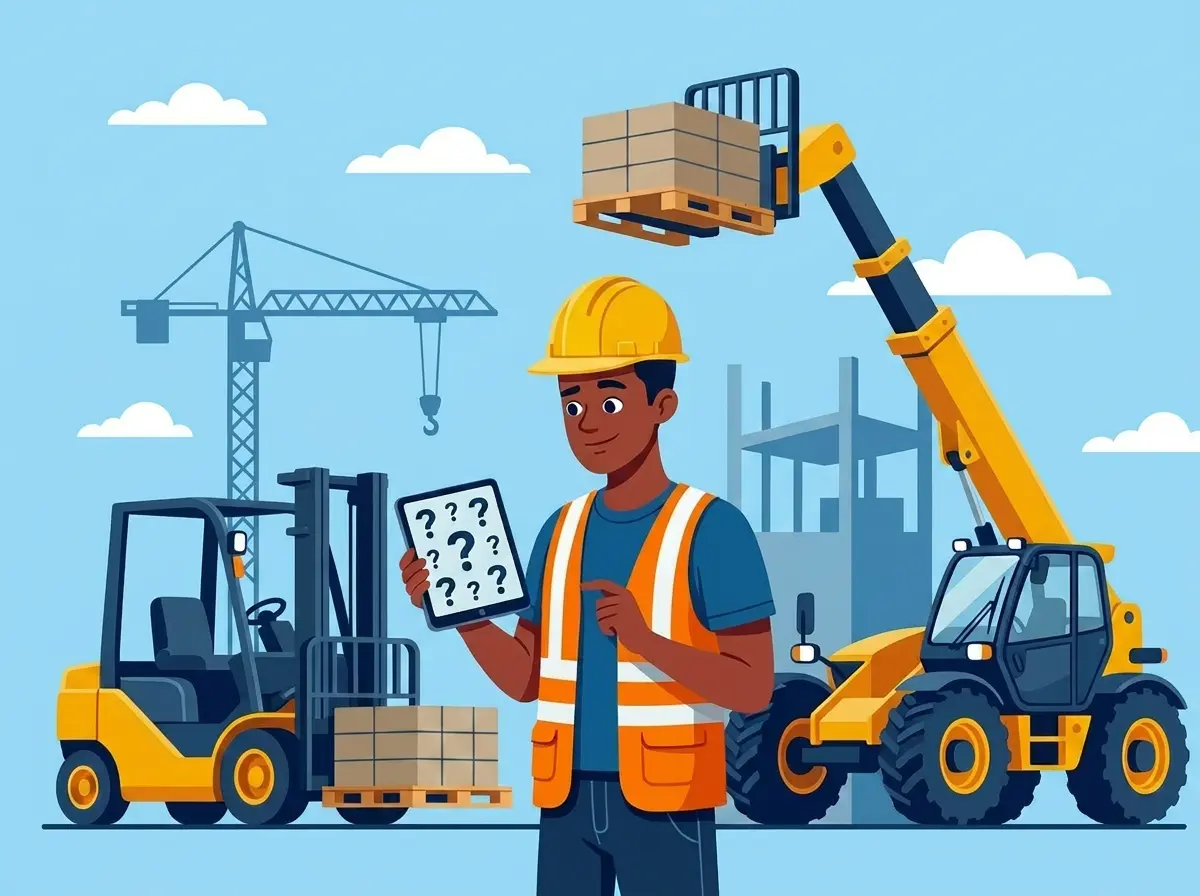
When you have a job that needs lifting, the right machine might not always be clear. A telehandler and a forklift can look functionally similar, as they both move heavy materials with forks. However, how each machine lifts, moves, and handles different jobsite conditions can lead you to very different rental decisions.
If you already know what a telehandler is and the basic types of forklifts, the next question is more practical: when comparing telehandler vs. forklift, which machine makes the most sense for the job?
A telehandler uses a telescopic boom to lift materials forward and upward. By contrast, a forklift is a more compact lift truck built to move and stack materials efficiently on flat, controlled surfaces. Their differences in design and function can impact how these machines support your operations.
Telehandler vs. Forklift: The Core Mechanical Difference
The biggest difference between a telehandler and a forklift is the lifting structure itself.
A telehandler — sometimes referred to as a variable reach forklift because of its extending telescopic boom — uses a boom to lift materials forward and upward.
The telescopic boom gives a telehandler the ability to lift materials upward and outward at the same time. Operators can place loads over walls, onto rooftops, into upper floors, or across trenches without needing the machine to sit directly below the drop point.
Because the boom extends forward, telehandlers are built with a wider chassis for stability and often have an offset cab design. Typical telehandler lift heights often exceed 40 feet, which makes this machine especially useful on construction sites where reach matters as much as lift.
A forklift, on the other hand, is built around a fixed mast and rear counterweight for straight-up lifting. It is generally more compact, sits lower to the ground, and performs best when lifting and stacking pallets on flat surfaces. Most outdoor or warehouse forklift models lift in the 10- to 20-foot range, though lift height can vary depending on the forklift mast types used.
Terrain and Operating Environment
Even if both machines can lift and move materials, they are built for very different ground conditions. For many renters, this is one of the fastest ways to narrow their decision.
- Telehandlers are built for rough, uneven terrain. They typically use large pneumatic off-road tires and often four-wheel drive, giving them high ground clearance. This equips them for construction sites, farms, or outdoor yards with dirt or mud.
- Standard forklifts have smaller solid or semi-pneumatic tires intended for smooth, flat surfaces like warehouse floors or paved yards. They are not designed for rocks, mud, gravel, or deep ruts. They shine in indoor work or flat dock areas where precision and compact size matter.
Differences in Gradeability
Gradeability is another important point of separation. Telehandlers can typically climb steeper slopes than standard forklifts, which is one reason they perform better on uneven outdoor sites.
For example, a large rough-terrain telehandler may achieve about a 25-degree slope, or roughly a 45% grade, when unloaded. A typical warehouse electric forklift may handle only about a 10% grade, while a larger diesel counterbalance model may reach around a 38% grade.
That said, a telehandler’s safe slope can drop significantly when carrying a heavy load or when the boom is extended.
Rough-Terrain Forklift vs. Telehandler
There is also a middle-ground option: the rough-terrain forklift, sometimes called an RT forklift. These machines are designed with oversized tires or four-wheel drive to improve traction on dirt yards and uneven outdoor surfaces.
However, they still use a vertical mast rather than a telescopic boom. In practice, that means an RT forklift can help close the gap in off-road mobility, but it still lifts more like a traditional forklift, usually in the 10- to 20-foot range.
It can be a smart choice for outdoor pallet handling, but it will not provide the same reach or placement flexibility as a true telehandler.
Reach and Lift Height: The Difference Between a Telehandler and a Forklift
An important part of any reach truck vs. counterbalance forklift comparison is how high — and how far — each machine can actually lift.
With standard forklift mast types, most forklifts max out at 36 feet in lift height. Specialized reach trucks and narrow-aisle models can go higher, but those are usually built for specific warehouse tasks rather than general jobsite use.
Telehandlers are built for both height and forward reach. Many mainstream models exceed 40 feet of vertical lift, while heavy-duty construction telehandlers often reach 50 to 70 feet. More importantly, that lift comes with outreach. A 40-foot telehandler can often provide nearly 30 feet of forward reach, while larger machines may extend more.
If the job involves placing materials on upper floors, setting roofing loads, or reaching areas the machine cannot drive directly beneath, a telehandler is usually the better fit.
Forklift vs. Telehandler: Load Capacity
Both a telehandler and a forklift may be rated to handle substantial loads, but they do so in distinctly different ways.
A counterbalance forklift generally carries more weight at ground level than a telehandler of similar size or cost. It is purpose-built for picking up and moving palletized loads on firm, level surfaces, with a forklift load center that stays closer to the mast.
A telehandler, by contrast, gives up some ground-level lifting efficiency in exchange for reach and flexibility. Because it uses a telescopic boom, its lifting capacity changes more noticeably depending on how high and how far forward the load is placed.
This is why telehandler lift capacity and weight are closely tied to boom position. A telehandler may handle a heavy load with the boom retracted, but that same capacity can drop as the boom extends.
This tradeoff is what makes a telehandler so useful on construction sites. You gain the ability to place materials farther forward and higher up, but not the same dense, close-in load handling that a forklift is designed to deliver.
Attachments and Versatility
Some jobs only require straightforward material movement. Others change throughout the day and call for one machine to support multiple tasks across the site. This is where the difference between a forklift and a telehandler becomes more noticeable.
The Versatility of Telehandlers
A telehandler is generally more versatile than a forklift. Its boom design allows it to support a wider range of attachments that go beyond simple pallet handling. With pallet forks, it can move materials much like a forklift.
The same machine can also take on other functions with the right attachment. Buckets, augers, truss booms, winches, grapples, and personnel platforms, when permitted and properly configured, allow a telehandler to do more than lift and carry. That flexibility makes it useful on construction sites where the day’s tasks may shift.
The Focused Function of Forklifts
A forklift can also use attachments, but the purpose is usually more specialized than expansive. Options like side shifters, clamps, rotators, and extensions help the operator handle loads more precisely or accommodate specific material types.
Those additions improve efficiency, but they do not fundamentally change what the machine is built to do. A forklift remains focused on moving, lifting, and positioning palletized or containerized materials.
Operator Requirements
Choosing the right machine is only part of the decision. It’s also important to ensure the person operating it is trained for that specific equipment and site.
OSHA requires powered industrial truck operators to be trained and evaluated before using equipment in the workplace. Training typically includes formal instruction, practical training, and an evaluation of the operator’s performance.
For a telehandler, that training needs to go beyond basic operation. Operators should understand how boom angle and extension affect safe lifting, especially on uneven ground, in active construction areas, or near structures and overhead hazards.
A forklift also requires OSHA-compliant training and evaluation. While the operating environment is often more controlled, the operator must still be trained on the specific truck type and its operating conditions.
Forklift vs. Telehandler: Which One Should You Rent?
The right choice comes down to the kind of work you need done.
A telehandler is not automatically the better option because it reaches farther, and a forklift is not automatically the better choice because it can handle more weight at ground level. What matters is how the machine fits your jobsite and load placement needs.
A telehandler is usually the better fit for jobs involving rough terrain, active construction conditions, or material placement at height. Because it can reach both forward and upward, it is more useful when loads need to be placed on elevated work areas or in spots the machine cannot drive directly beneath. It also makes more sense when one machine needs to support multiple tasks across the site.
In summary, choose a telehandler if:
- Your work environment is more like an active construction site than a warehouse or loading dock.
- Your site has rough terrain, mud, gravel, uneven grades, or limited access.
- You need to place materials on upper floors, rooftops, platforms, or other elevated points.
- You need forward reach, not just vertical lift.
- You want one machine that can support multiple jobsite functions with different attachments.
A forklift is often the more practical option when the job centers on moving heavy materials efficiently across flat, stable ground. It is designed for straightforward lift-and-place work and can often handle dense palletized loads with less complexity than a telehandler.
In many cases, a forklift rental also makes sense when cost, maneuverability, and repetitive material handling are the main priorities.
Choose a counterbalance forklift if:
- You are mainly moving palletized materials on flat, stable surfaces.
- Ground-level lifting capacity is more important than reach.
- You need tight maneuverability in a warehouse, yard, dock, or other confined area.
- Your workflow depends on repetitive material movement rather than multi-role jobsite support.
- You want a simpler machine for straightforward loading, unloading, and stacking.
- Cost per day is a priority, since forklifts are often less expensive to rent than telehandlers with comparable lifting capacity.
Find the Right Lift for the Work Ahead at BigRentz