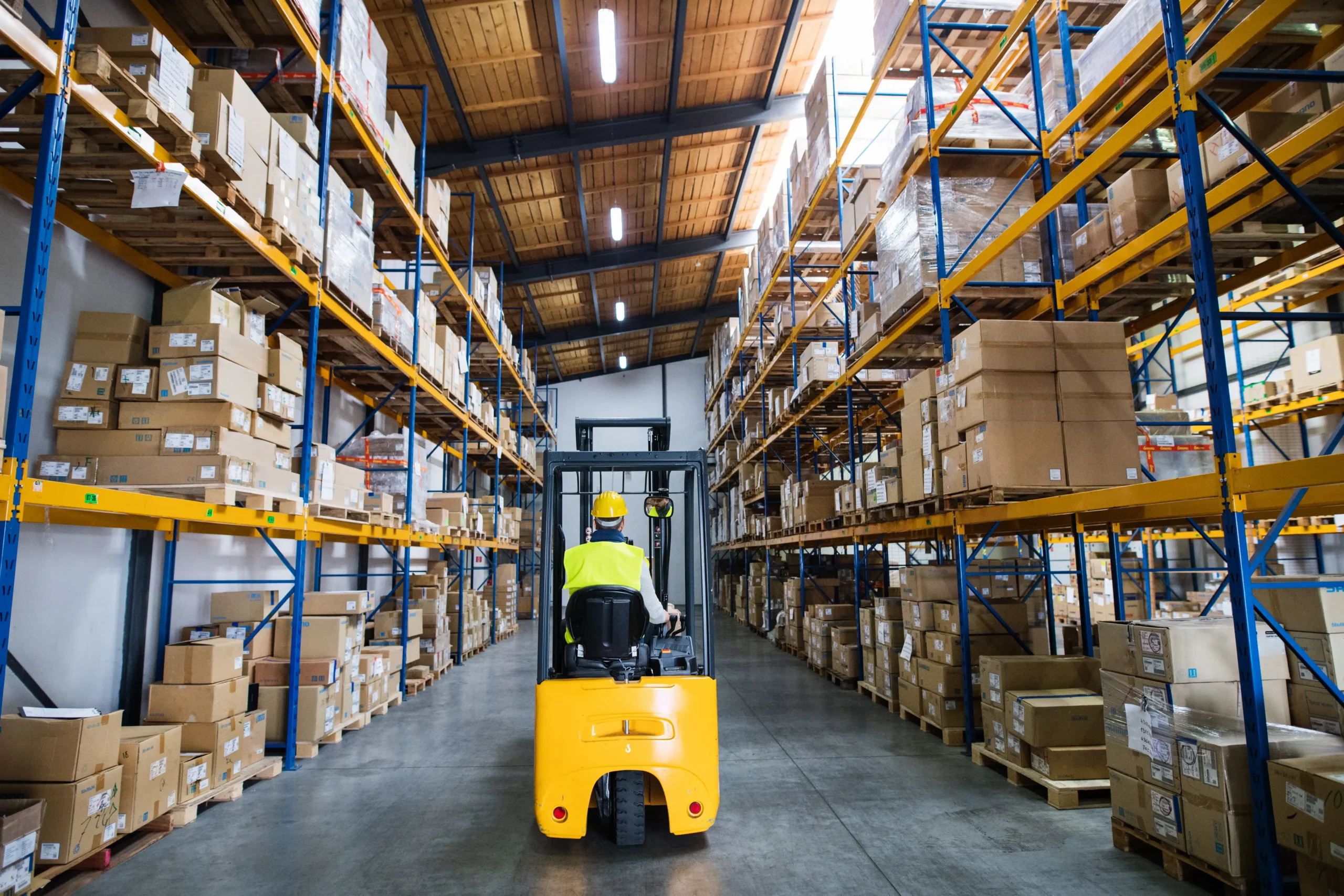
Deciding how wide to make your aisles is one of the most important decisions you’ll make when determining your warehouse layout, and it’s not always a clear-cut choice. Wider aisles can accommodate more forklift types and provide sufficient room to turn, but they decrease the number of rack rows the facility can fit.
On the other hand, tighter aisles mean more space for inventory. However, you’ll be limited to the types and sizes of forklifts you can use. You’ll also have to pay much closer attention to safety and compliance: narrow aisles leave less room for error and may increase the risk of collisions and other workplace accidents.
While the Occupational Safety and Health Administration does not set one fixed forklift aisle width, OSHA does require safe, unobstructed travel areas. In this post, we’ll cover how to calculate the aisle width for a forklift and how to choose the best setup for your operation.
OSHA Forklift Aisle Width Requirements: What OSHA Actually Says
When planning aisle clearance, the width is often estimated by adding a few inches on each side for the widest vehicle or load that will pass through it.
This estimate is likely based on an OSHA interpretation letter from 1972, which recommended three inches of clearance or an aisle width of at least four feet. While this type of guidance is based on industry convention, it is not a requirement and does not appear in current OSHA standards.
Although OSHA does not have forklift aisle-width standards, it does have aisle-marking requirements and safety standards. According to OSHA’s walking‑working‑surfaces rule (29 CFR 1910.22) and the powered‑industrial‑truck standard (29 CFR 1910.178), aisles used by forklifts must be kept clear and properly marked.
In practice, that means the aisle has to be wide enough for the forklift, its load, and the movements needed to operate it.
Disclaimer: This post is not legal or compliance advice. For decisions specific to your facility, consult the full OSHA standard or a qualified safety professional.
Forklift Aisle Widths for One-way Traffic
Many forklift safety and materials‑handling sources describe about 8 feet as a working minimum aisle width for one‑way traffic with a standard counterbalance forklift and typical pallet loads. This recommendation is determined by combining the width of the machine and load, plus a small safety margin. The actual minimum aisle width for a forklift in your facility will depend on:
- The specific forklift
- Its load size
- Its turning radius or right‑angle stacking requirements
Forklift aisle width also depends on the OSHA forklift class and the type of equipment being used, since narrow aisle trucks are designed for tighter spaces than standard counterbalance models.
Forklift Aisle Widths for Two-way Traffic
For two‑way traffic, clearance needs to account for two vehicles passing each other. There should also be side clearance and a gap between the vehicles. This is typically within the 18–22 ft range for standard counterbalance equipment, depending on load size and layout.
Aisle Marking Requirements
Aisles and passageways must be kept clear and appropriately marked. Most industry sources recommend placing permanent floor lines that are at least 2 inches to six inches wide.
Markings help clearly separate forklift travel lanes from pedestrian areas and storage areas. An unmarked, improperly designated aisle can be a citable hazard, even if the width provides enough room for the equipment.
How Minimum Aisle Width for a Forklift Is Calculated
The calculation starts with the widest point of the load or forklift, whichever is larger.
- A standard counterbalance forklift is typically 40–44 inches wide at its widest point, usually the counterweight. But the load often sets the real number.
- A standard 48×48-inch pallet with any side shift or overhang can push the total width to 60 inches or more.
From there, add 3 inches of clearance on each side:
Load or vehicle width + 6 inches = minimum straight-travel aisle width
While this standard forklift aisle width calculation is appropriate for straight-line travel, right-angle stacking requires a separate calculation.
Right-angle Stacking Calculation
One of the most common warehouse layout planning mistakes is measuring the straight-travel aisle width correctly, only to find that the forklift can’t complete the turn into the rack bay.
Right-angle stacking is where the forklift turns 90 degrees to enter a rack bay. The space needed for that turn is significantly larger than the minimum for straight travel. When measuring aisle widths for a forklift, account for its turning radius plus load overhang as the machine pivots.
Always check the manufacturer’s right-angle stacking aisle spec for any machine you’re evaluating to determine whether a forklift can operate in your racking layout. For reference data on machine widths, see our guide to forklift machine dimensions and widths.
Aisle Width Requirements by Forklift Type
Aisle width requirements vary among different types of forklifts. Matching the right machine to your layout before you finalize racking helps ensure your facility runs efficiently and doesn’t create daily operational headaches.
Counterbalance Forklift (Standard)
The counterbalance forklift is the most common forklift in general warehousing. Most existing warehouse layouts are designed around its clearance requirements.
- Straight-travel Aisle: Typically 11–13 ft for one-way traffic with standard pallet loads
- Right-angle Stacking Aisle: Typically 12–13 ft, depending on model and load size
These represent the widest aisle requirements among common forklift types, which is why facilities aiming to increase storage density often consider reach trucks.
Reach Truck
A reach truck has a mast mechanism that extends the forks into the rack without the machine body crossing the rack face, which allows it to operate in narrower aisles. That can improve storage density, while still leaving enough room for safe maneuvering and load handling.
- Straight-Travel Aisle: Typically 8–10 ft
- Right-Angle Stacking Aisle: Typically 8.5–10.5 ft
A 3–4 ft reduction in aisle width compared to a counterbalance translates directly into additional rack rows on the same floor. Reach trucks are the standard choice when storage density is the priority.
For a detailed comparison of how these two machines differ in practice, see our counterbalance vs. reach truck guide.
Narrow Aisle Machines (Order Pickers, Turret Trucks, Swing-Reach)
Narrow aisle machines can operate in aisles as tight as 5.5–6.5 ft. They require floor rail or wire guidance systems and specialized floor flatness tolerances that most standard facilities don’t have.
For a full breakdown of narrow aisle forklifts and aisle width, see our guide to narrow aisle forklift types and configurations.
Walkie Rider Pallet Jack
Walkie riders have the smallest footprint of any powered material handling equipment. Some models can navigate aisles as narrow as 5 ft, making them useful in facilities where forklifts handle putaway and pallet jacks handle order picking in tighter spaces.
One-Way vs. Two-Way Aisle Traffic
The choice between one-way and two-way forklift traffic has a bigger impact on floor space than most facilities account for during initial planning.
- One-way aisles require clearance for a single machine plus a 3-inch margin on each side as a general rule of thumb.
- Two-way aisles must accommodate two machines passing at the same time. That means double the machine width, plus clearance on each side and a gap between the two vehicles.
For two standard counterbalance forklifts, which typically require 18–22 ft of aisle width, depending on load sizes.
Most modern warehouse designs use one‑way aisle systems with defined traffic direction, because two‑way aisles take up significantly more floor space. However, without clear, consistent directional floor markings, one‑way layouts can run the risk of head‑on collisions.
Pedestrian Separation Requirements
OSHA 1910.176 and industry best practices state that where pedestrians and equipment, such as forklifts, share a space, aisles must be wide enough to accommodate both safely. In facilities with frequent foot traffic, many safety plans set a minimum of about 4–5 ft for a dedicated pedestrian walkway alongside forklift lanes.
Alternatively, facilities can physically separate pedestrian paths from forklift lanes. Physical barriers such as bollards and guardrails, as well as clearly painted separation lines, can be used.
Building pedestrian separation into the initial aisle layout is significantly cheaper than retrofitting barriers after racking is already installed.
What Happens When You Change Forklift Type
Before you rent a forklift, it’s important to factor in the width of your aisles. It’s not enough for it to just fit: it also needs to be able to maneuver, even with a full load. Otherwise, you could run into difficulties.
Switching from a reach truck to a counterbalance is the most common source of problems. Aisles designed for reach trucks at 8–10 ft will almost certainly be too narrow for a standard counterbalance to complete right-angle stacking. That’s a problem you want to identify before the machine arrives on site, not after.
Switching from a counterbalance to a reach truck works in reverse. Your existing 12–13 ft aisles will accommodate a reach truck, but you’ll have more space than the machine needs. If the move to reach trucks is permanent, that extra space is an opportunity to reconfigure for higher rack density.
Renting a smaller machine for a short-term project doesn’t automatically mean it will fit in your facility’s aisles. A smaller forklift still has a published right-angle stacking aisle requirement, and that spec doesn’t necessarily scale proportionally with machine size. To be sure, confirm the manufacturer’s specifications for the model you plan to rent.
Specifying your aisle width when placing a rental order helps ensure your machine can be safely and correctly used in your facility.
Practical Planning Checklist Before Ordering a Forklift
Before you order a new forklift or finalize rack positions, take a few minutes to review your facility’s layout and your operation’s equipment needs. Running through this checklist helps you identify potential issues early on.
- Measure aisle widths at the narrowest point, not the average, especially near rack bays and tight corners.
- Identify the widest load that will travel through each aisle, rather than just the width of the forklift body.
- Confirm the manufacturer’s published right‑angle stacking aisle requirement for the specific model you’re considering.
- Identify all pedestrian crossing points and confirm that walkways are clearly separated from forklift travel lanes, with markers or barriers where needed.
- For new builds or major reconfigurations, engage a licensed warehouse layout specialist before locking in rack positions.
Taking these steps early makes it much easier to match the right forklift to your space, keeping your layout both efficient and compliant.
Find the Right Forklift for Your Facility
BigRentz is the largest construction and industrial equipment rental platform in the U.S., with access to inventory across more than 6,000 rental partners and 14,000 locations nationwide. Whether you need a reach truck, a counterbalance, or any other type of powered industrial truck, we can help you find the right machine for your facility’s layout.
Browse our forklift rentals, and request a quote online today.