Forklift collisions, particularly with pedestrians involved, are among the leading causes of forklift-related fatalities in the U.S., accounting for 36% of forklift-related deaths. Excessive travel speed is a contributing factor in a significant proportion of those forklift accidents.
OSHA does not mandate a universal speed limit for operating forklifts. Employers bear full responsibility for setting appropriate limits for their operations and for enforcing those guidelines, along with other safety protocols.
This guide covers the regulations set by OSHA and how you can set appropriate speed limits for forklift drivers in your facility based on the existing operating environments at your site.
What OSHA Actually Requires — and What It Doesn’t
OSHA 29 CFR 1910.178(n)(8) requires that forklift operators travel at a safe speed. In this case, what counts as a “safe” speed is one at which the truck can be brought to a stop. However, the regulation does not provide a specific number. It sets a performance requirement, not a numerical speed range that can be enforced across facilities.
In practice, OSHA holds employers responsible for determining what “safe speed” means in their own facility. When complying with this regulation, site managers can provide a written speed limit policy that is consistently enforced and incorporated into their operator training documentation.
What Happens During an Investigation
OSHA can and does cite employers under the general duty clause (Section 5(a)(1)) when a speed-related incident occurs and where there is no written speed policy existing in your organization. A speed-related incident in the absence of a documented policy signals to inspectors that the employer did not take reasonable steps to prevent the hazard.
In other words, even though there is no mandated numerical speed limit for operating a forklift, it does not change the assessment during the investigation.
State-Level Regulations
Some states have adopted workplace safety regulations through OSHA State Plans that may include more specific forklift speed requirements. However, the requirements vary by state, and some plans have adopted specific limits or zone-based rules. Check your state OSHA plan alongside the federal standard to confirm which requirements apply to your operation.
Important Note: This guide doesn’t provide legal advice. For guidance on the OSHA forklift speed limit standard as it applies to your facility, consult OSHA directly or a certified safety professional.
Recommended Speed Limits by Environment
The speed ranges below are not OSHA mandates. They represent practical benchmarks widely adopted across the industry and referenced by safety organizations, including ANSI and the Industrial Truck Association. Use them as a starting point for your written policy, adjusted to your facility’s specific conditions.
| Recommended Speed Limit | |
|---|---|
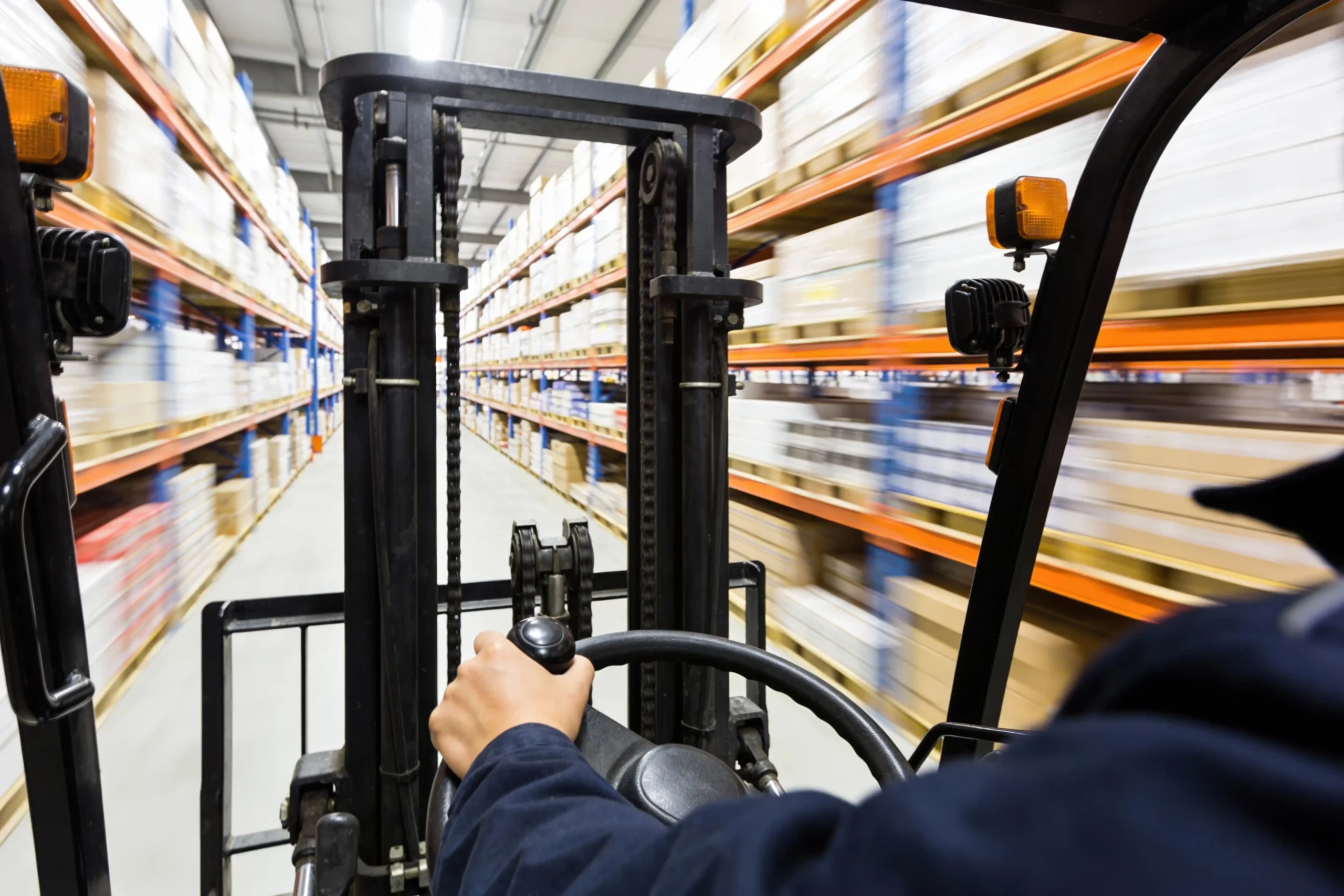
| General Warehouse Aisles | 5 mph is the widely cited standard for the speed limit for forklifts in warehouse aisles during loaded travel. In high-traffic areas, pedestrian crossings, and intersections where sightlines are limited, the common benchmark is 3 mph. |
| Loading Docks and Trailer Entry | 3 mph is the typical maximum speed when approaching a dock or entering a trailer. The confined space and proximity of dock workers leave little margin for error. Bring the machine to a near stop before crossing the dock plate. |
| Pedestrian Crossings and Shared Areas | 3 mph or lower. Some facilities require a full stop and a horn signal before crossing any marked pedestrian path. Blind corners at rack ends carry particular risk: operators and pedestrians often cannot see each other until they are only a few feet apart. |
| Ramps and Inclines | All ramps require speed reduction. The relationship between ramp grade, load position, and stopping distance is covered in detail in forklift ramp and slope guidance. Ramp operations should carry their own speed designation in your written policy. |
| Outdoor Yards and Open Areas | 10 mph is a common upper limit for open outdoor surfaces without pedestrian traffic. Wet, uneven, or gravel surfaces require further reduction regardless of the posted limit. |
The Physics of Forklift Stopping Distance
A forklift carries weights differently compared to other load-bearing machines and vehicles. The combined center of gravity for machine and load sits near the front axle, elevated above the floor. A sudden stop will throw that weight forward, increasing the risk of tip-over during abrupt braking compared to steady travel.
For a detailed explanation of forklift stability mechanics, see our forklift stability triangle guide.
Estimating Braking Distance
The braking distance for a forklift does not increase proportionally with speed. It actually increases with the square of speed. For example, a forklift traveling at 8 mph requires approximately four times the stopping distance of one traveling at 4 mph.
Adding a load weight compounds this computation for the machine’s braking space. A 5,000-lb forklift carrying a 4,000-lb load has more kinetic energy than the machine’s weight alone would suggest. At 6 mph, its stopping characteristics are those of a 9,000-lb vehicle, not a 5,000-lb one.
Braking technique should be part of forklift operator training as much as the posted speed limit on your site. Read our forklift controls and braking guide for more information.
Driver Reaction Times
At higher speeds, the time interval between the driver’s reaction and the mechanical braking of a forklift tends to increase. Fatigue and distraction also impair a driver’s ability to react quickly to hazards. The posted speed limit in your guidelines sets the ceiling, but it should also factor in the operator’s condition.
Speed and Load Position
Traveling with a raised load reduces a forklift’s stability at any speed. As load height increases, a forklift’s stability decreases, and setting speed limits appropriate for floor-level travel becomes inadequate without accounting for load positioning.
Some operators focus on overhead clearance, raising loads to clear dock lips or uneven floor sections while still in motion. These practices increase their risk of tipping over and reduce the effective stopping distance.
At BigRentz, we have provided best practices for load position fundamentals in our forklift load center guide.
How To Set and Document a Forklift Speed Policy
Each area of your facility carries a different risk profile, and your policy needs to reflect that. These components represent the minimum of what a documented speed program should cover:
- Zone-Specific Speed Limits: Assign separate speed designations to each zone. This helps with compliance with OSHA standards in high-risk areas.
- Posted Signage at Every Zone Entrance: Post physical speed limit signs at every zone entrance, dock entrance, and pedestrian crossing.
- Operator Training Documentation: OSHA expects documented proof that operators were informed of facility-specific speed requirements, not just the general principles covered in how to drive a forklift training.
- Unladen and Ramp Travel: Address unladen and ramp travel separately, each with its own speed designation in the written policy.
- Contractor and Third-Party Operators: Make sure to include contractor operators and third-party logistics workers explicitly in the guidelines.
- Policy Documentation and Review: Document the policy, obtain signed acknowledgment, and review it after near-misses and operator changes.
A written policy defines the standard for your site. Whether it holds in day-to-day operations depends entirely on how you enforce the policies.
Enforcement Methods
Posting speed limits and documenting a policy are the tools to help operators follow guidelines consistently in daily operations. Consider the following:
Speed Governors
A speed governor sets the ceiling in the system, and the machine won’t exceed the speed limit, regardless of what the operator does. Most modern forklifts support this natively, but older equipment can be retrofitted.
Telematics and Fleet Management Systems
These are GPS-based systems that can record exactly how fast each machine traveled and when. For large or spread-out fleets, there’s no practical way to know whether speed policy is being followed without it.
Physical Infrastructure
Adding speed bumps and rumble strips naturally slows a forklift down. Placing them at strategic points enforces the rules without requiring direct supervision.
Supervisory Observation and Near-Miss Reporting
Supervisor observation and near-miss reporting help you enforce speed limits. Near-miss data helps you track violations early and gives management concrete action items.
Operator Incentive Structures
Operators under throughput-based systems face pressure to move faster, and speed limits are often the first thing to go. Review your productivity targets and confirm they do not work against your speed policy.
Special Considerations for Forklift Speed Limit Inside a Factory and Manufacturing Environments
The forklift speed limit set by OSHA inside a factory is generally lower than in a general warehouse. Operators need to pay attention to higher pedestrian density, fixed machinery, and narrow corridors as they drive around a facility, leaving less margin for error.
Workers on a production floor are focused on their tasks, not on forklift traffic. The burden on speed management is correspondingly higher.
You can designate forklift corridors in your facility with physical barriers rather than painted lines. Where volumes justify it, that separation is more reliable than any posted limit. If you’re interested in forklift hazards in industrial environments, we have provided a detailed guide that covers the risks you should be aware of.
Find the Right Forklift for Your Operation
BigRentz supplies forklifts for warehouse, dock, and outdoor operations, with nationwide delivery for short and long-term rentals. Browse our forklift rental inventory to find the right configuration for your project.