Cranes are the most effective way to move heavy loads on various projects. Renting offers the easiest access to different types of cranes on a daily, weekly, or monthly basis without the added investment or logistics of purchasing one.
Construction teams can rent cranes through a national online rental network or a local crane service. In some cases, online networks help you find equipment through a local partner, providing the convenience of online searching and the ease of working with a nearby company.
Before renting a crane, read on to learn about the following:
- Prices for average crane rentals
- Factors that affect the rental cost
- Advantages of renting a crane instead of buying one
Average Crane Rental Cost
Prices can vary depending on several factors, but average crane rental costs can range:
| Crane Type | Average Range |
|---|---|
| Small Crane | $200 to $500 per hour |
| Mobile Crane | $300 to $700 per hour |
| Large Crane | $500 to $1,500 per hour |
| Tower Crane | $15,000 to $60,000 per month |
Because each model has unique features and specifications, there is no simple answer to how much it costs to rent a crane. The best way to get an accurate estimate is to request a quote from a trusted vendor.
Nonetheless, it helps to know the average crane rental prices. Besides the crane rental costs, make sure you consider additional costs that may be involved:
- Lift Capacity: A bigger crane generally costs more. However, capacity isn’t just measured by “tons” and is also based on boom length, counterweights, and how far you need to reach. The more demanding the lift chart requirements, the higher your rental cost tends to be.
- Delivery and Assembly: Cranes must be delivered to the job site. Smaller cranes offer more flexibility and can be moved around on-site or between locations, while larger cranes are placed in a fixed position.
- Permits: Cranes require permits to operate, so check your local jurisdiction for the fees and paperwork involved. Your jobsite location may also come with additional access and site conditions that influence pricing.
- Qualified Personnel: All cranes require certified operators, riggers, and signal persons to ensure safe lifting. Some crane rentals can also include certified operators to handle the equipment for your team.
Crane Rental Cost Per Hour
Most crane hourly rates can range from $150 to $1,200, depending on the size and other factors that can affect pricing and delivery.
| Crane Type | Average Hourly Rental Rate (Crane Only) | Best For | Factors That Affect Rate |
|---|---|---|---|
| Small Crane | $150 to $350/hour | HVAC units, small steel, short lifts | Mobilization, boom length, local availability |
| Mid-Sized Mobile Crane | $250 to $600/hour | Commercial construction, setting trusses/steel | Heavier picks, longer radius, permitting/traffic control |
| Large Crane | $400 to $1,200+/hour | Large structural picks, bigger job sites | Engineering, counterweight config, escort vehicles |
Many service providers that offer rental cranes per hour require a daily minimum number of hours, which can range from three to eight hours.
Additional fees can apply to:
- Overtime rates
- Crane operator fees
- Additional rigging and crane-related equipment
- Fuel surcharges
- Road permits and other fees
Crane Rental Cost Per Day
Day rates bundle time into a predictable block, making the crane rental cost per day easier to budget. This is the more practical option when setup, waiting on crews, or multiple picks will stretch the workday.
| Crane Type | Average Daily Rental Rate (Crane Only) | Best For |
|---|---|---|
| Small Cranes | $300 to $600/day | Crews handling moderate lifts across a full workday, such as sign companies and solar roofing specialists |
| Mid-Sized Mobile Crane | $800 to $1,500 per day | General construction and subcontractors that need steady lift capacity, but not extreme heavy lifting |
| Large Crane | Upwards of $2,000/day | Heavier picks in the industrial and infrastructure sector that perform longer-radius lifts requiring more capacity |
Many customers compare hourly pricing with daily pricing. Ultimately, the best choice is based on how long you expect to use your crane.
Hourly pricing is often better for quick, well-planned lifts where you can get in and out fast. However, it can backfire if you hit delays and keep paying the clock. If you’re comparing the cost to rent a crane for a day vs. hourly, ask how hours are counted, whether there’s a minimum, and what triggers overtime.
In practice, the right choice comes down to your schedule. Simple lifts favor hourly rentals, while complex jobs with moving parts favor a day rate because the effective crane cost per day can be lower once real-world downtime is included. If you’re asking how much to rent a crane for a day, treat the base rate as only one line item.
Crane Rental Cost by Crane Type
Crane pricing varies by crane type because each machine solves a different kind of lift problem.
| Crane Type | Typical Pricing Structure | Average Rental Cost | Best For |
|---|---|---|---|
| Mobile Crane | Hourly or daily rate, often with minimum hours | Mobile crane rental cost ranges from $155 to $1,500, depending on class. | Steel picks, setting HVAC units, precast panels, bridge/utility work – applications that require a crane to mobilize to the site quickly. |
| Tower Crane | Weekly or monthly rates | Tower crane rental cost is often quote-based. | High-rise and long-duration builds where the crane stays on site and lifts materials all day. |
| Crawler Crane | Daily, weekly, or monthly rates | Crawler crane rentals can vary from $300 to $1,500/hour, or upwards of $2,000 per day for larger units. | Heavy picks and long-duration jobs where the crane needs stability and capacity, such as industrial plants and large structural work. |
| Rough Terrain Crane | Hourly or daily rates | Most rough terrain cranes costs range from $300 to $600/day. | Uneven ground, active construction sites, and places a truck crane can’t comfortably set up. |
| Spider Crane | Daily rates | These are quote-based, as units vary widely by size and access constraints. | Tight-access and indoor/outdoor confined spaces, including glass installation, atriums, and finished floors, where you need a compact crane that fits through doors or elevators. |
Crane Rental Cost by Capacity
Capacity or tonnage is one of the biggest drivers of crane pricing.
| Crane Type | Typical Cost (Hourly / Daily) | Best For |
|---|---|---|
| 50 Ton Crane Rental Cost |
|
|
| 100 Ton Crane Rental Cost |
|
|
| 200 Ton Crane Rental Cost |
|
|
| 500 Ton Crane Rental Cost |
|
|
Cost To Rent a Crane With an Operator
Many rental providers offer these cranes “bare,” meaning the cost covers only the crane itself. However, if you need an operator for your crane equipment, expect to add $50 to $150 per hour to the standard rental costs. This additional crane operator cost can be billed separately, though some may provide an all-in quote for crane rental rates with an operator.
| Crane Type | Average Bare Rental | Average Crane Rental With Operator |
|---|---|---|
| Small Crane | $150 to $350/hour | $200 to $450/hour |
| Mid-Sized Mobile Crane | $250 to $600/hour | $400 to $750/hour |
| Large Crane | $400 to $1,200+/hour | $750 to $1,200+/hour |
An operator may be necessary depending on your in-house team’s capabilities and the type of crane your project requires.
Some factors to consider:
- Operator Hourly Rates: Certified crane operators are skilled specialists, and their crane hire costs reflect the risk and responsibility of operating heavy equipment safely.
- Certification Requirements: Many job sites and local regulations require documented operator credentials.
- Insurance and Liability: Many rental companies often require operated-and-maintained rentals because they reduce risk, especially on higher-capacity lifts.
Factors That Affect Rental Cost
Other details can influence a crane’s total price, as it can affect the logistics, labor, and risks. Understanding the main drivers behind crane rental pricing can help you compare crane rates for your project.
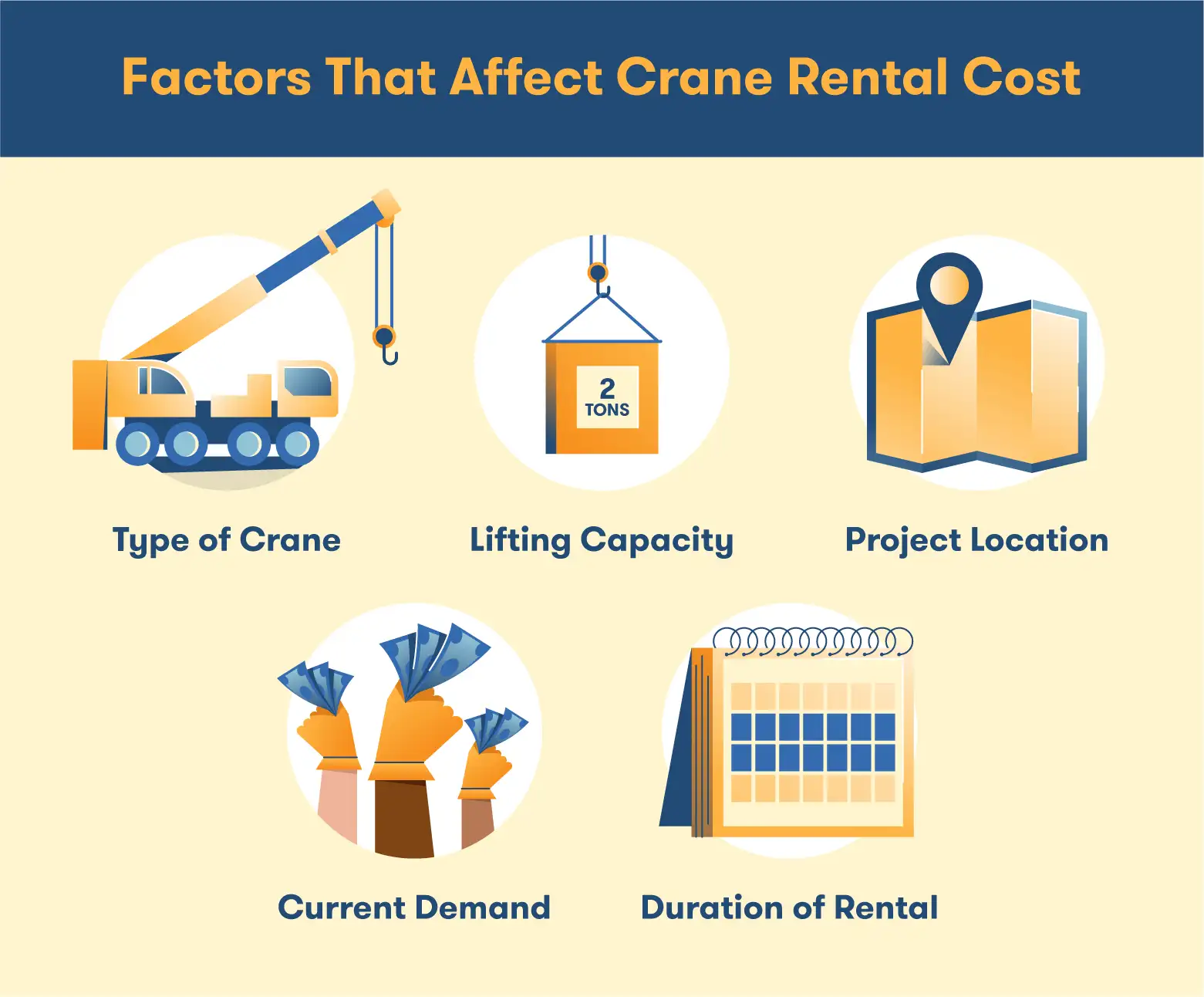
These are the main factors in determining the cost to rent a crane:
- Type of Crane: Specialized cranes incur higher crane charges due to the added complexities of mobilization, configuration, and operation. Small carry deck cranes are relatively more affordable than tower cranes, for example.
- Crane Size: Bigger cranes cost more because they involve heavier components, more counterweight options, and more complex logistics. Even within the same type, moving up in size often increases the base crane rate and the add-on costs.
- Lifting Capacity: The more a crane can lift, the more it will cost. Some of the largest mobile cranes can haul over 1,000 tons. If your pick requires more capacity at reach, you may need a larger class crane, which raises overall crane rental pricing.
- Project Location: Prices vary by region, but location also affects access, traffic control needs, and how far the crane and crew have to travel. Remote or congested sites often lead to higher charges due to longer mobilization times and more complex delivery logistics.
- Current Demand: When cranes are booked out during busy seasons or major local projects, rates can rise due to limited availability. If your schedule is flexible, off-peak timing can sometimes lower the quote.
- Rental Duration: While it is usually more expensive to rent a crane for extended periods, it may be more practical to opt for monthly or weekly rates, depending on your use. Short rentals may still trigger minimum hours and portal-to-portal billing, which can make a quick job cost more than expected.
- Transportation: Getting the crane to the site can be a major line item, especially for larger units that require multiple loads or special routing. Longer distances, escort requirements, and time-of-day restrictions can all increase rental pricing.
- Operator Cost: If the rental includes an operator, their labor costs are either built into the quote or itemized as an hourly add-on. Higher-skill operators, union requirements, and off-hours work can impact rates.
- Permits: Some lifts require permits for oversized loads, street use, lane closures, or even the lift plan itself, depending on the jurisdiction and site rules.
- Setup Time: Some cranes offer more flexibility, while others require positioning, deploying outriggers, assembling jib sections, and doing test picks. When setup is complicated by tight access or ground conditions, it can increase costs.
Considering these factors will help you better understand the total price when requesting a quote.
Example Crane Rental Project Costs
Even with these average estimates, real-world crane quotes can ultimately vary. Here are a few examples of how this can look like in practice:
- HVAC Installation: A one-day rooftop unit swap requires multiple picks plus setup and standby. These projects often use a 50 or 100-ton class crane and are commonly billed as a minimum half-day or full-day block. Depending on site access, the number of units, and how long the crew needs the crane on standby, HVAC crane service costs often fall in the low thousands to several thousand dollars per day.
- Steel Beam Lifting: For setting a few beams, the crane might only “lift” for an hour, but you’re still paying for travel, setup, and minimum hours. If the steel is heavier or the reach is longer, moving from a 50-ton to a 100-ton class crane can be more effective but increase costs.
- Tree Removal: Crane-assisted removals are usually priced around how long the crane is needed while the tree crew cuts and rigs sections. Tree removal crane cost is commonly several thousand dollars when you factor in the crane, operator, mobilization, and the time-on-site needed to safely piece the tree down.
- Construction: Larger lifts often require higher-capacity cranes and more planning time. Even when the lift itself is straightforward, the total can rise fast due to heavier mobilization, longer setup, and the fact that these cranes are typically billed in longer blocks.
Crane Rental Cost vs. Buying a Crane
For some businesses, buying a crane may be the more practical option. However, you need to consider several factors beyond the cost to buy a crane.
When people ask how much does a crane cost, the real answer depends on type and capacity: smaller units can start in the low six figures, while many new mobile cranes land in the high six figures to several million, and heavy-duty units can reach multi-millions. However, the price of a crane is only the start of your expenses. Ongoing costs, such as repairs, tires/tracks, rigging, insurance, and downtime, can make ownership a less practical solution for many businesses.
| Factor | Renting a Crane | Buying a Crane |
|---|---|---|
| Financing | Limited to deposits and first invoices, so capital stays available for other needs | Requires significant capital or financing |
| Cost Predictability | Predictable for short jobs | Predictable monthly ownership costs, but repair spikes and downtime can be hard to forecast. |
| Utilization | Best when crane needs are occasional or vary by job | Best when the crane has high utilization |
| Flexibility by Project | Easy to match capacity or type to each lift | Locked into what you own |
| Availability and Scheduling | Subject to local supply and network | Full control over scheduling |
| Maintenance and Inspections | Usually handled by the rental provider | Responsible for maintenance, inspections, recordkeeping, and compliance requirements |
| Staffing and Training | Operator may be included as part of an operated rental | Requires hiring in-house operators and managing training, certification, and coverage |
| Insurance and Liability | Can be simpler with operated rentals, but still requires jobsite coverage and COIs | Long-term insurance responsibility that covers the risks during storage |
| Mobilization and Transport Logistics | Provider coordinates transport | Arrange hauling, permits, routing, escorts and storage every time you move it |
| Downtime | If a unit goes down, the provider may swap equipment | Breakdowns directly impact your schedule and revenue |
| Key Advantages |
|
|
Advantages of Renting a Crane
Though purchasing a crane can be a reliable long-term investment for some companies, most teams are better off renting for many reasons.

Consider these points if you want to buy a crane:
- Less Capital Investment: Purchasing a crane requires significant capital, which is impractical for many companies that can’t afford the upfront cost and ongoing ownership costs. Renting a crane saves money without lowering productivity.
- No Transportation and Storage Costs: Transporting a crane to your job site and storing it when it’s not in use can incur additional charges.
- No Maintenance Costs: If you buy a crane, you’re responsible for regular maintenance to ensure safe operation.
- More Flexibility: When you buy a crane, you are limited to its specifications and capabilities.
- No Depreciation Costs: A crane is a depreciating asset, which reduces the value of your investment over time until it reaches the end of its lifespan.

By contrast, crane rentals offer flexible pricing, short-term savings, and no depreciation costs. Additionally, since you can rent a different crane for each job, you’re not stuck with a single model that isn’t ideal for future situations. Finally, renting means you won’t have to perform maintenance on your crane or store it between projects, saving you money over time.
Frequently Asked Questions (FAQs)
How much does it cost to rent a crane per hour?
Most hourly rentals fall in the $200 to $1,000 per hour range. Smaller mobile cranes tend to sit toward the lower end, while larger cranes and specialty lifts push hourly rates up. However, keep in mind that hourly rentals may have a minimum number of hours.
How much does it cost to rent a crane for a day?
A conservative range would be around $1,500 to $10,000 per day, depending on various factors.
How much does a crane operator cost?
A crane operator typically adds about $50 to $150 per hour on top of the equipment rate.
What is the cheapest crane to rent?
The cheapest options are usually small mobile cranes because they’re faster to mobilize and have lower base rates. However, the “cheapest” quote for your project can change if your application requires more reach or capacity.
What size crane do I need?
Crane size is determined less by the weight you’re lifting and more by the heaviest pick at the required reach, along with boom length, setup, and site conditions. The best way to determine the right size is to contact our team for recommendations.
Find Cranes for Rent Near Your Area
When you’re ready to start your next job, BigRentz’s online rental network can help you rent a crane that’s most suited to your project. Request a quote on the crane you need for detailed pricing information, or browse our available crane rental equipment.