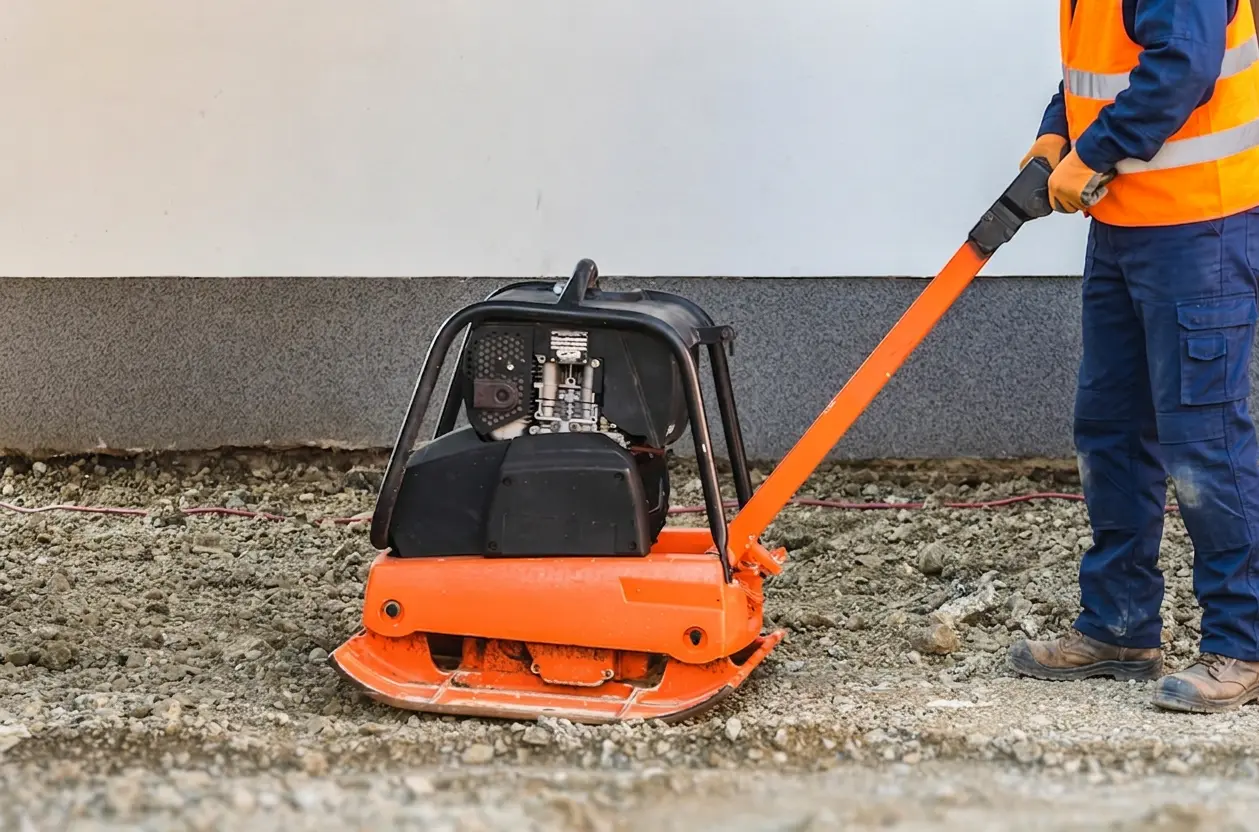
For flat-work site prep, plate compactors are the walk-behind workhorse. They deliver repeatable energy across a wide, even footprint while an engine-driven exciter box generates high-frequency vibrations that efficiently tighten granular base materials.
However, not all compactors are the same. The machine you choose must match your material and how the unit has to move through the space. A poor match can mean extra passes, inconsistent density, and even settlement risk that later shows up as cracking or low spots.
This comprehensive guide can help you choose the right plate compactor type for your job, ensuring your finished surface holds grade under real traffic.
Start With the Material You’re Compacting
Consider what you’re compacting and how its factors – particle size, moisture, and cohesion – influence how materials respond to vibration. Matching centrifugal force, amplitude, and vibration frequency to the subgrade protects density and reduces wasted passes.
Granular Soils (Sand and Gravel)
Low-cohesion particles in sand and gravel generally densify quickly under high-frequency vibration. Dry sand requires a lighter force, while thicker gravel bases need more mass and stronger vibration to lock larger aggregate into a stable layer.
Cohesive Soils (Clay and Silt)
The particles in cohesive soils are fine and platy, resisting surface vibration. Clay-heavy soils usually compact better with impact or kneading action from a rammer or roller that drives out air and water.
Hot Mix Asphalt (HMA)
Hot asphalt is highly sticky, so a plate compactor must be fitted with a gravity-fed water sprinkler system. The water prevents the hot binding oils from adhering to the steel base plate and tearing the surface.
Interlocking Pavers and Decorative Stone
Steel plates can scuff pavers. Contractors use high-frequency paver setups or add a polyurethane/rubber pad to seat units and drive joint sand without damage.
Forward Plate Compactors
Forward plate compactors (single-direction plates) are the most common, accessible option in many rental fleets. A single rotating eccentric shaft inside the exciter box generates a downward compaction force while also producing forward drive, so the machine “walks” itself across the surface instead of needing constant pushing.
Typical units weigh about 110 to 265 lbs (50 to 120 kg) and deliver roughly 3,000 to 5,500 lbs of centrifugal force (10 to 20 kN). This mix of lighter weight and straightforward control makes them quick to set up and efficient on straight runs.
The Advantage of Forward-Only Travel
Steady self-propulsion (often around 20 to 25 meters per minute) lets you focus on keeping a clean line and consistent overlap. Safety improves as well, since the plate isn’t moving backward into obstacles or toward your boots.
Reversible Plate Compactors
Reversible plate compactors add bidirectional travel, letting you shift between forward, neutral, and reverse with a control lever. Extra mass drives higher output: many units weigh roughly 265 to 1,100 lbs (120 to 500 kg) and generate about 5,000 to 10,000 lbs of centrifugal force (25 to 60+ kN).
Job types that benefit most share the same pattern: thicker lifts, longer runs, and tighter spaces where turning a machine around slows you down.
- Deep Trench Work: Compacts backfill in long, narrow trenches where turning around is physically impossible or time-consuming
- Road Construction and Sub-bases: Packs coarse gravel and crushed stone to carry heavy loads
- Commercial Site Prep: Consolidates base and detail areas near foundations and parking edges
Lever-controlled reverse allows backtracking over the same line, improving coverage while reducing operator strain.
Vibratory Plate Compactors
Vibrations are the operating principle behind most modern types of compactors. Static weight only presses the surface, but an engine-driven exciter box spins weighted shafts to generate rapid vertical vibration. This, in turn, drives densification. Particles get shaken loose until they fall into open air pockets and lock together into a denser matrix.
Frequency vs. Amplitude
Two key mechanical metrics govern the performance of vibratory plate compactors:
- Frequency describes how fast the plate cycles. For example, high-frequency machines deliver rapid, shallow vibrations.
- Amplitude refers to the “strokes,” or how far the vibrating mass moves each cycle.
Plate compactors that deliver high-frequency, low-amplitude vibrations are a great match for asphalt and delicate pavers. On the other hand, low frequency and high amplitude support thicker sub-bases and deeper lifts.
Plate Compactor Comparison by Project Type
Different plate designs deliver energy differently. Load demands and jobsite geometry can impact what feels most efficient once production starts.
Driveway Preparation
Many driveway builds call for at least 6 to 8 inches of crushed stone or road base. Reversible plate compactors deliver the mass and centrifugal force needed to lock larger aggregate deep in the lift, then reverse straight back without wrestling a heavy machine at every turnaround.
Walkways
Walkways are usually narrow and shallow, often with about 4 inches of aggregate in a 3- to 4-foot corridor. A 14- to 18-inch forward-plate compactors unit stays easy to steer, fits tight edges, and supplies enough force for thin lifts.
Patio Installation
Patios demand control around corners and borders, so lighter plates are easier to place accurately. However, it’s important to note that these hardscape features also feature sensitive materials. A forward unit paired with a polyurethane pad settles pavers into bedding sand without damaging them.
Retaining Walls
For the wall’s gravel base course pad (typically a narrow 4- to 6-inch-deep trench), a small forward plate fits in the trench and allows for highly precise leveling. However, for the backfill behind the wall, a hydraulic compactor attachment on a mini-excavator lets you compact from a safer position while applying consistent hydraulic energy.
Utility Trenches
Trenches for water, sewer, gas, or conduit leave little room to pivot equipment. A narrow reversible plate runs forward, then walks backward along the same path, maintaining consistent coverage without constant repositioning.
Asphalt Patching
Hot mix needs vibration to seat fine aggregate into a tight surface, and higher-frequency vibratory plate compactors support that finish.
Commercial Foundations
Foundation subgrades and structural slabs can’t tolerate hidden soft spots, and forward plates often lack the weight and stroke for thick lifts. Heavy reversible units help compact thicker granular lifts where access is limited, while larger rollers typically handle the main pad.
Parking Lots
Parking lots require uniform support across a broad footprint. Reversible plates work well for edges and detail zones, while ride-on rollers cover open runs faster.
Landscaping Projects
Landscape prep can take place in standard-sized homes with tight access for equipment. Compact forward plates provide controlled vibration for turf bases, planting beds, and smaller hardscape elements.
Plate, Size, Compaction Force, and Productivity
Comparing price or engine brand alone is a common mistake when choosing plate compactors for rent. Productivity comes from how the machine covers ground and reaches target density without wasting passes.
- Plate Dimensions: Wider plates cover more area per pass on open runs, while narrower plates fit tight spaces and can concentrate energy where access is limited.
- Centrifugal Force: A higher force from the exciter system helps lock particles faster, often cutting pass counts on granular bases.
- Travel Speed: Self-propel speed affects how quickly you can complete long, straight runs without bogging down production.
- Compaction Depth: This is the maximum lift thickness the machine can densify effectively from the top down. Lift thickness that exceeds the compactor’s capability can leave loose material at the bottom.
- Pass Requirements: Fewer required passes usually mean better schedule control, especially on larger footprints.
- Surface Coverage: Surface coverage estimates how much ground you can compact per hour based on plate width and travel speed.
Choosing Between Plate Compactors and Other Compaction Equipment
While plate compactors are popular, other compaction machines can outperform them when vibration isn’t the right action, or when the footprint is too large for walk-behind production.
Jumping jacks, also called tamping rammers, rely on vertical impact rather than vibration. A narrow shoe concentrates high-amplitude force into cohesive soils like clay and silt, which tend to absorb surface vibration instead of settling into a denser structure. Clay-heavy ground can also bog a plate down, making a rammer the more reliable option for confined, sticky conditions.
Smooth drum rollers solve a different problem and offer fast, uniform compaction across large areas. Drum weight combined with vibration delivers high production rates on roadway subgrades and expansive paving runs.
Ride-on rollers also lead on large parking lots and municipal streets, while plates still earn their place on edges, around obstacles, and in tight detail zones.
Wacker Plate Compactors: Understanding the Term
On many jobsites, you’ll hear “wacker plate” or “wacker” used as shorthand for a plate compactor. The nickname comes from Wacker Neuson, a long-established manufacturer. Because Wacker Neuson machines were the standard on job sites for decades, contractors began referring to any light compaction equipment as Wacker plate compactors.
While it is commonly understood and acceptable job site slang, relying on this term during the rental process can lead to costly mismatches. “Wacker” doesn’t really tell a rental team what force, plate size, or travel mode you need.
When renting ground compactors, it’s best to describe exactly what you need. Travel direction, centrifugal force, lift thickness, and the material you’re compacting will point you to the right rental.
What To Consider Before Renting a Plate Compactor
Opting for plate compactors for rent can be a cost-effective way to achieve professional-grade results, but the real value comes from renting the right fit.
Project Size
Smaller areas often favor lighter forward plates that are easy to maneuver. Larger driveways and commercial paving usually justify heavier reversible units that cover ground faster and require fewer repositionings.
Soil Type
Identify the material first. Granular sand and gravel respond well to vibration, while clay and silt often require impact compaction with a rammer or trench roller to reach density.
Lift Thickness
Compaction happens in layers, so consider the lift depth. Lift thickness exceeding the machine’s effective depth can leave loose material beneath the surface, creating hidden voids that can lead to settlement or low spots. Deeper backfill zones and structural driveway bases often push you toward heavier reversible plates with higher centrifugal force.
Machine Weight
Heavier machines generally transfer energy deeper, which can reduce passes on thicker base lifts. Lighter units win when access and control have more weight than the surface’s depth.
Transportation
Confirm how the equipment will get to the site and unload safely. Many forward plates fit in a pickup, while heavy reversibles may require a trailer or mechanical loading help.
Fuel Type
Power choice affects more than runtime. Electric or battery options may be necessary indoors, in tunnels, or on emission-sensitive sites where exhaust becomes a safety issue.
Operator Experience
Lighter plates feel intuitive for newer operators. On the other hand, heavier reversible plates demand more control and awareness, especially in tight zones or on slopes.
Job Duration
One-day compactor rental can work for a single-phase patio prep. Projects that span multiple phases or weather windows often cost less overall on a weekly or monthly basis, since you avoid paying for multiple pickup and return cycles.
Common Mistakes When Selecting a Plate Compactor
Using the wrong compaction strategy can undermine an otherwise well-built project. Avoiding these common selection mistakes helps protect base density and long-term surface performance.
- Choosing Based Only on Machine Size: Size alone doesn’t tell you how the machine will perform on your material or lift plan. Oversized units can be overkill on thin layers, while undersized plates can leave deeper zones loose.
- Ignoring Soil Conditions: Standard vibratory plate compactors perform best on granular materials. Clay and silt often need impact or kneading action from a rammer or trench roller to reach density.
- Using Lightweight Compactors for Deep Compaction: Single-direction units can create a firm crust while leaving loose material below.
- Selecting Oversized Equipment for Confined Spaces: Tight trenches and corners make heavy machines harder to manage.
- Skipping Moisture Considerations Before Compaction: Bone-dry material and saturated soil can compact poorly. Without workable moisture, particles don’t rearrange and lock together.
How To Choose the Right Plate Compactor
As we close out this guide, here’s a checklist you can use for a quick cross-check:
- Start With the Material: Granular sand and gravel respond well to vibration from standard plates. Asphalt work requires a water system to prevent the plate from tearing the mat, and pavers require a protective pad to avoid chips and scuffs.
- Match the Machine to the Footprint: Short, narrow runs often favor a lighter forward plate you can steer precisely. Bigger areas and longer passes tend to reward heavier reversible units that maintain coverage without constant repositioning.
- Think in Lifts: Lift thickness beyond the machine’s effective depth can leave loose zones hidden beneath the surface.
- Let the Layout Dictate Travel Direction: Open lanes make forward-only work practical, while trenches, corners, and tight pads benefit from reverse travel so you can back out cleanly.
- Balance Productivity With Handling: Wider plates, higher force, and faster travel can speed up open work, but tight obstacles often call for agility over brute strength.
- Plan Logistics Early: Transport, loading, and unloading requirements can quickly eliminate options, especially for heavier reversible plates.
Avoid Soft Spots — Find the Right Plate at BigRentz
Compaction tasks are often highly specialized, requiring different machines for different phases of a single project. If you’re evaluating plate compactors for rent, BigRentz can help you select equipment that fits your scope and site realities. Call us at 855-999-5438 for rental guidance and support getting the right compaction setup in place.
Frequently Asked Questions
What is the difference between a forward and a reversible plate compactor?
Forward plates travel in one direction and are lighter and easier to guide on straight runs. Reversible plates move forward and backward with a lever, adding weight and force that improve efficiency on larger areas, thicker lifts, and tight zones where turning around slows you down.
What materials can a vibratory plate compactor compact?
A vibratory plate performs best on granular materials like sand, gravel, crushed stone, and well-graded base. Performance drops on cohesive clay or silt, where vibration tends to get absorbed instead of driving densification.
When should I rent a reversible plate compactor?
Rent a reversible unit for thicker granular lifts, longer passes, or confined layouts such as trenches, foundation edges, and tight pads. Bidirectional travel helps you backtrack cleanly and maintain consistent coverage without constant repositioning.
Are plate compactors suitable for asphalt?
Yes, for smaller patches and edges, especially with a plate designed for asphalt and a water system to prevent sticking. Large paving runs typically require rollers to meet production and density targets.
How do I choose the right plate compactor size?
Match plate width to the space you need to cover and the access points you have to work through. Wider plates boost coverage on open runs, while narrower plates fit trench lines, walkways, and tight corners.
How many passes does a plate compactor typically require?
Pass count depends on the material type, moisture content, lift thickness, and machine force. A granular base might reach density in a few overlapping passes, while thicker lifts or tougher conditions may require more passes.